
Large-aperture fisheye lenses typically feature an aperture of f/2.8 or wider, allowing for greater light intake in low-light conditions and enabling the creation of unique effects that are difficult to achieve with standard lenses.
Large-aperture fisheye lenses combine ultra-wide angles, large apertures, and unique distortion characteristics to produce unique and impactful visual effects in low-light environments.
1.Stunning images of the starry sky and Milky Way
Astronomical photography is one of the core applications of large-aperture fisheye lenses, as the large aperture can capture more starlight and clearly record the Milky Way and stars.
The fisheye lens’s 180-degree field of view allows the vast Milky Way and the landscape to be captured in a single frame without the need for post-processing stitching; simultaneously, the large aperture brightens the foreground, reducing the contrast between the landscape and the sky to achieve a more balanced overall exposure.
2.Dynamic and creative city nightscape
The large-aperture fisheye lens supports handheld shooting of city night scenes, which can exaggeratedly include tall buildings and narrow streets in the picture, and the traffic lights will form a very impactful light trail.
With long exposure, the lens curves the paths of light sources into arcs that sweep across the frame, producing visual effects reminiscent of a “space-time tunnel” or an “energy sphere.”
When a large-aperture fisheye lens is pointed directly at a point light source such as a street lamp or neon light, it will produce very exaggerated, even radiating glare or ghosting that covers the entire image. In low-light environments, this glare often becomes the visual center of the image, giving it a cyberpunk or psychedelic feel.
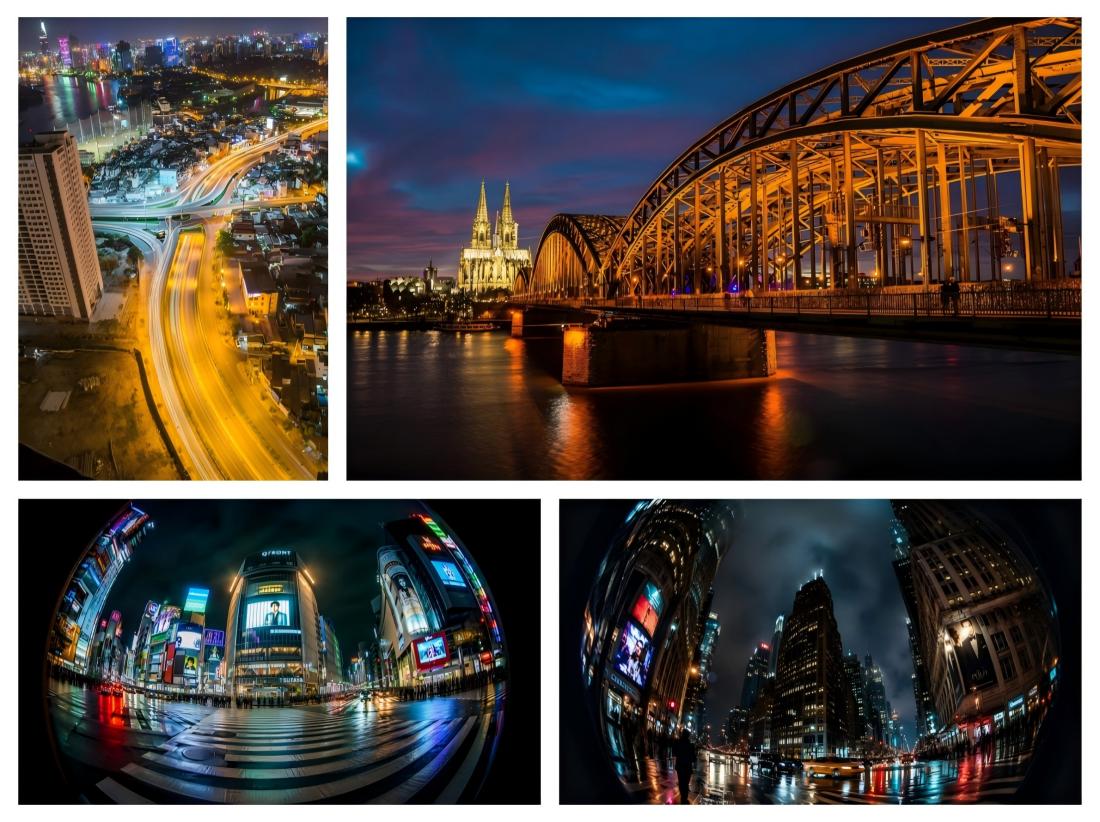
Large aperture fisheye lenses are often used to shoot creative urban night scenes
3.The depth and delicacy of the underwater world
In the typically low-light environment of the underwater world—where tripods cannot be used—the wide-aperture advantage of a fisheye lens truly shines; it captures the subtle interplay of light, shadow, and color on the seabed, ensuring the image remains clear and vivid despite the gloom.
4.Dramatic effect of portrait
Fisheye lenses produce pronounced distortion, so they are generally not recommended for portrait photography; when using one for portraits, the subject should be positioned in the center of the frame to avoid severe distortion.
However, for creative purposes, one can leverage the lens’s distortion and the shallow depth of field afforded by a wide aperture to capture portraits with a sharp subject and a dreamy, blurred background—creating a highly striking visual impact.
5.The unique atmosphere of the interior space
In dimly lit indoor settings—such as bars or museums—a wide aperture enables you to capture sharp, natural-looking handheld shots without the need for a flash. The exaggerated perspective distortion of a fisheye lens can make even cramped spaces appear vast and deep, creating a powerful visual impact.
A wide aperture allows photographers to clearly convey the relationship between the subject and the surrounding environment without sacrificing shutter speed, while simultaneously using the subtle background blur characteristic of wide apertures to make the subject stand out.
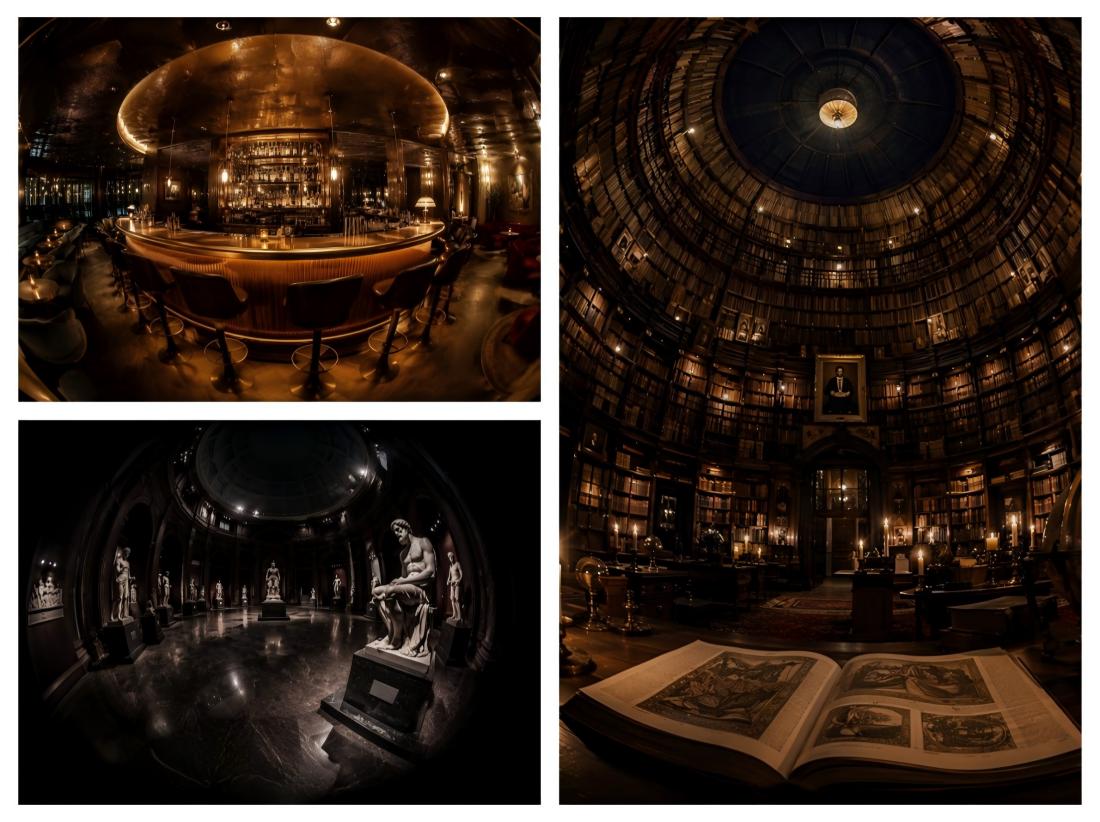
A large aperture fisheye lens can capture the unique atmosphere of an interior space
6.Dreamlike effect captured at extremely close range
When shooting at extremely close range with a wide-aperture fisheye lens, the central subject remains sharp, while the edges and corners exhibit a highly exaggerated blur (creating a “tunnel” effect). In low-light conditions, when combined with point light sources, this effect can evoke a powerful sense of dreamlike atmosphere and three-dimensionality.
In conclusion, large-aperture fisheye lenses can produce grand, bright, clear, and dreamlike photos in low-light environments, and have unique applications in Milky Way astrophotography, urban street photography, indoor photography, and creative photography.
Post time: Sep-24-2026


