
1.What is relative illuminance?
The edges of the object appear noticeably darker; can this be improved? Today we’ll look at this parameter—relative illumination.
Definition: Illuminance is the degree of brightness exhibited by an object or surface when illuminated by a light source.
Relative illumination refers to the ratio of the brightness at the edge of the field of view to the brightness at the center, expressed as a percentage. It is a parameter that characterizes the optical phenomenon caused by a portion of the light entering the lens being blocked or reduced. In optical design, the relative illumination curve provides a visual representation of the brightness at various positions in the field of view relative to the center.
2.What factors affect relative illuminance?
(1)Fourth power of cosine Law
The brightness at the edge of the field of view decreases proportionally, and this is related to the fourth power of the cosine of the viewing angle. The fourth power of cosine law is an important principle describing the attenuation of light intensity at different angles, and it is particularly applicable to the analysis of the radiation characteristics of point sources or small light sources under specific conditions.
When light from a point source is incident on a surface at an angle θ, the intensity (or irradiance) received by that surface is proportional to cos⁴θ, i.e., I(θ) = I(0)·cos⁴θ. Where:
I(0) is the light intensity when the light source is incident perpendicularly (θ=0°);
θ is the angle between the incident light ray and the surface normal;
I(θ) is the light intensity at angle θ.
This formula explains why some short focal length FA lenses exhibit a significant decrease in brightness at the edges. Because short focal length lenses typically have a large field of view, it’s easy to understand from the formula above that the edges will become much darker, even without the influence of any other factors.
(2)Vignetting
Some of the light rays are blocked by the lens barrel or the edges of the lens elements, resulting in a reduction of light energy received at the edges of the camera sensor. This phenomenon is called vignetting. The animation below visually demonstrates the formation of vignetting.
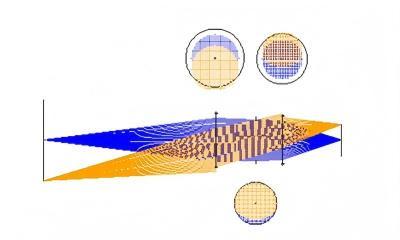
The formation of vignetting
In real-world lenses, due to the presence of aberrations, we sometimes need to artificially block some of the harmful marginal rays of light that affect image formation. This improves image quality, but it also increases vignetting, which in turn reduces relative illumination.
(3)The lens mount and chip size are incompatible
When the image circle of the lens is smaller than the diagonal size of the sensor, the edges of the field of view will naturally become darker or even completely black, at which point the relative illumination at the edges will become 0%.
3.How do you interpret a relative illuminance curve graph?
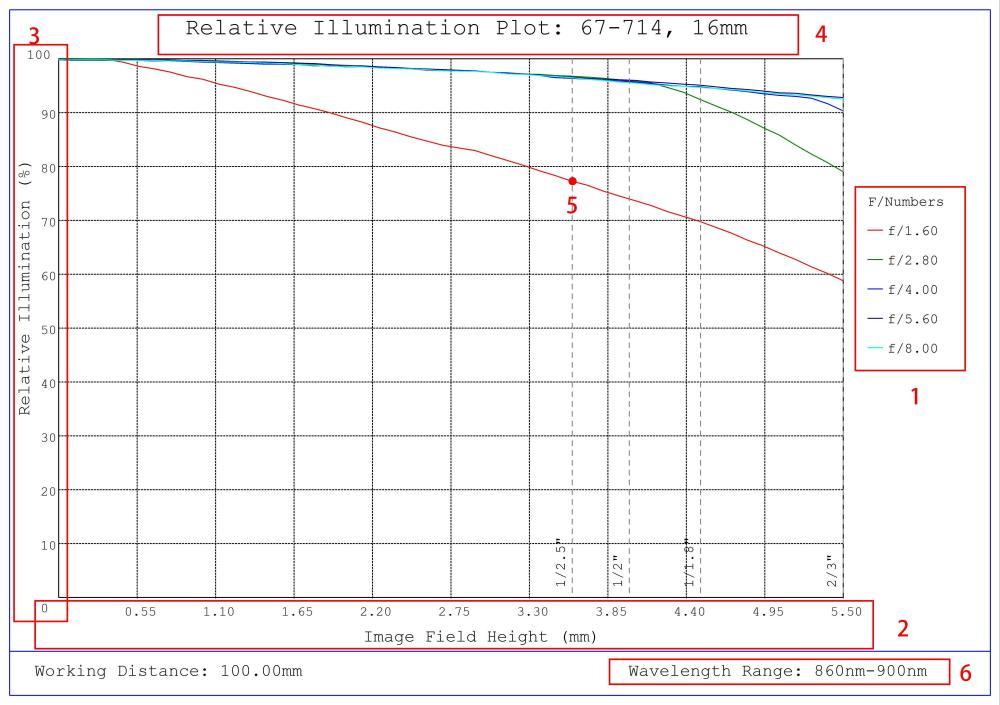
Relative illuminance map
In the image, point 1: The different colored curves represent the relative illuminance at different aperture settings.
In the image, point 2: The horizontal axis represents the different image heights of the lens (a half-image height mode is used, with the center being 0).
In the image, point 3: The vertical axis represents the numerical value of relative illuminance at three points.
In the image, point 4: This represents the name or drawing number of this lens.
Point 6 in the image: In which wavelength range was the lens illuminance curve tested?
Example:
Point 5 in the image: Measured with a 16mm lens at F1.6 aperture in the 860nm-900nm wavelength range, the relative illumination at a half-image height of approximately 3.5mm is about 78% compared to the center.
Final Thoughts:
By working with professionals at ChuangAn, both design and manufacturing are handled by highly skilled engineers. As part of the purchasing process, a company representative can explain in more detail specific information about the type of lens you wish to purchase. ChuangAn’s series of lens products are used in a wide range of applications, from surveillance, scanning, drones, cars to smart homes, etc. ChuangAn has various types of finished lenses, which can also be modified or customized according to your needs. Contact us as soon as possible.
Post time: Jan-27-2026


