
Line scan lenses constitute a critical component of machine vision systems. Their selection is a multidimensional, systematic undertaking—and indeed a pivotal stage—that necessitates a comprehensive assessment of the compatibility across various factors, including the entire line scan imaging system, the specific application scenario, and environmental conditions.
Overall, the following are the key considerations for selecting a line scan lens:
1.Core optical parameters
(1)Resolution: Lens resolution refers to a lens’s ability to resolve fine details; it must be matched to the camera’s pixel size and generally needs to exceed the camera’s pixel density to ensure that the minimum detection size is discernible. To achieve superior image quality, it is typically necessary to select a lens with higher resolution; if a low-resolution lens is chosen, the advantages offered by the camera’s high pixel count cannot be fully realized.
(2)Focal Length: The focal length of a lens serves as the link connecting working distance, field of view, and sensor size; it is the primary factor determining imaging magnification and influences both the spatial layout and optical path length of the system. A longer focal length results in higher magnification and a smaller field of view, making it suitable for inspecting small objects or for applications requiring high magnification; conversely, a shorter focal length yields lower magnification and a larger field of view, making it suitable for inspecting wide-format objects.
(3)Aperture and depth of field: Aperture size affects the amount of light entering the image and the depth of field. A wide aperture is suitable for low-light environments, though it may come at the expense of depth of field; conversely, a narrow aperture increases depth of field but necessitates stronger illumination. Generally, objects with irregular surfaces require a greater depth of field, necessitating a careful balance between aperture size and exposure time; however, when photographing high-speed moving objects or in applications requiring short exposure times, a wide-aperture lens should be selected to enhance image brightness.
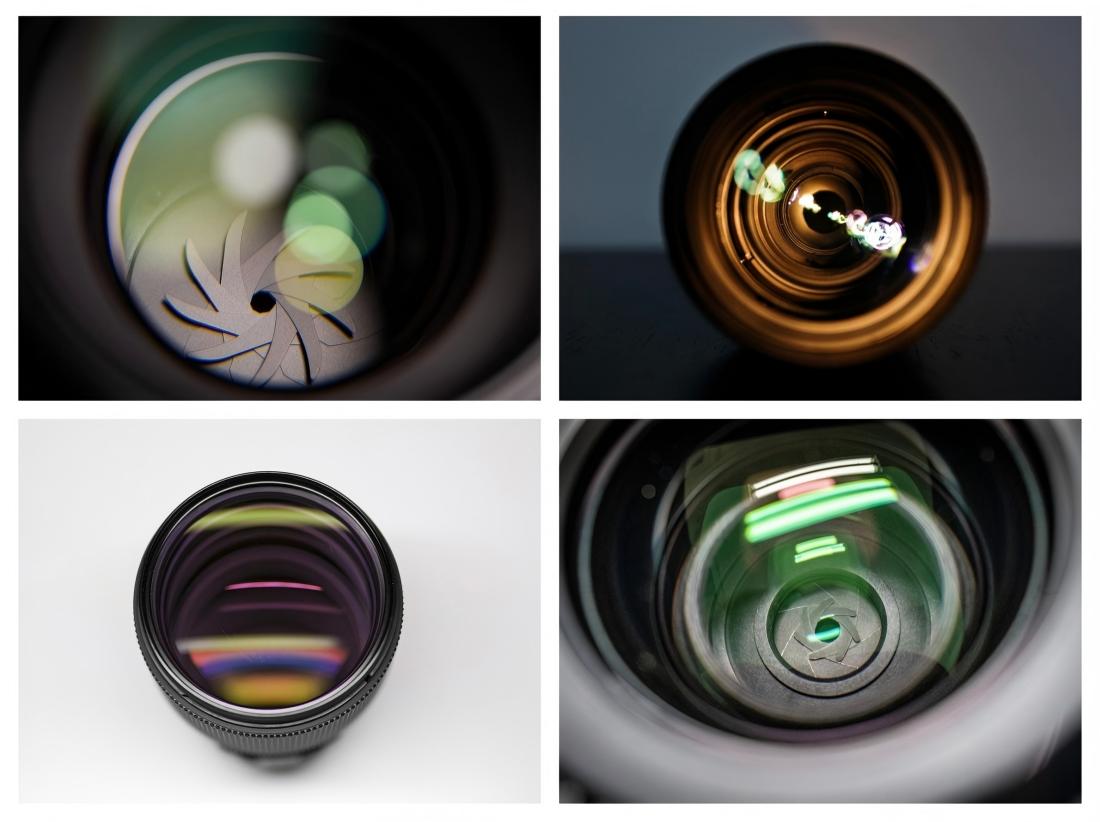
Aperture is a key parameter of line scan lenses
(4)Field of view and working distance: The field of view is determined by the focal length of the lens and the length of the camera’s sensor. The appropriate field of view needs to be determined according to the size of the shooting range. For example, when shooting large objects, a lens with a larger field of view needs to be selected. The working distance is determined by the mechanical structural design; it is essential to define the required range of working distances and, subsequently, select a lens that falls within this specific range based on the actual distance between the lens and the object in the practical application.
2.Mechanical and installation factors
First and foremost, the selected line scan lens must be compatible with the camera’s sensor size; this ensures the lens can fully utilize the sensor’s imaging area and prevents issues such as image distortion at the edges. Additionally, it is essential to verify that the chosen line scan lens matches the interface type of the camera or inspection system.
Common mount types include C, CS, F, and M42; an interface mismatch will render assembly or focusing impossible. Furthermore, in installation environments with limited space, one must also consider the impact of the lens’s physical dimensions and weight on the installation process.
3.Performance indicators
(1)MTF performance: MTF (modulation transfer function) measures the lens’s ability to resolve at different spatial frequencies, encompassing a wealth of information such as contrast, resolution, spatial frequency, and chromatic aberration. This indicator is particularly important in industrial testing where precise measurements are required. High MTF ensures fidelity of detail during line scanning; consequently, selecting a lens with superior MTF performance yields enhanced imaging results.
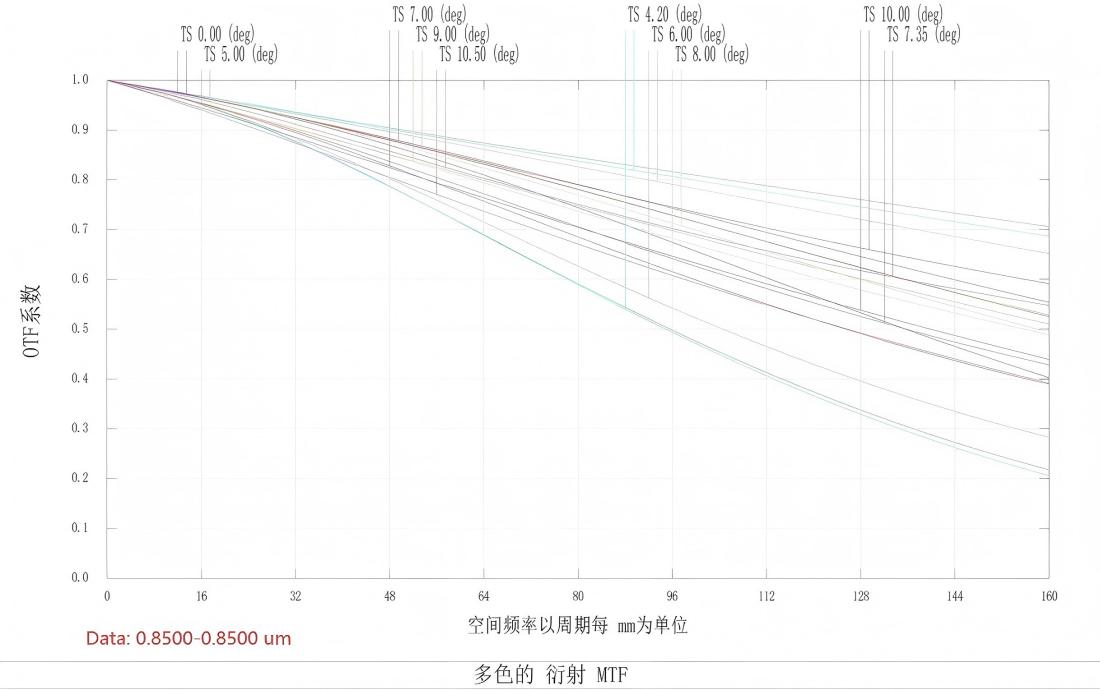
Lens MTF test results example
(2)Distortion and chromatic aberration: Distortion and chromatic aberration are common problems in optical systems. When selecting a lens, you should pay attention to the level of control over distortion and chromatic aberration. Line scan systems are extremely sensitive to geometric distortion, which can lead to measurement errors, and chromatic aberration can affect the imaging consistency across different wavelengths. Particularly in inspection scenarios demanding exceptionally high precision, it is imperative to select lenses characterized by low distortion and effective chromatic aberration correction; high-end line-scan lenses typically maintain a distortion rate of less than 0.05%.
(3)Image field uniformity: Line scan lenses are required to maintain a stable resolution throughout the entire image field, ensuring consistent sharpness in different areas of the image, with a sharpness consistency of over 98% between the center and the edges.
4.Image quality and special requirements
(1)Spectral matching: When the detection scene is visible light, infrared or ultraviolet, a lens with the corresponding spectral range should be selected to avoid spectral distortion and image attenuation. For example, if using a UV or IR camera, a UV or IR lens specifically designed to correct chromatic aberration for that band must be selected.
(2)Line rate: The line rate is determined by the production line speed, field of view width, and pixel size. The lens must maintain sufficient optical performance (MTF, light flux) at the required line rate.

Imaging quality and special requirements of line scan lenses
5.Usage environment and application requirements
When selecting a lens, it is also essential to choose a line-scan lens that offers high durability and strong adaptability—based on the specific usage scenario and application requirements—to ensure reliable operation and the achievement of desired results across various environments. For example, in harsh industrial environments (vibration, large temperature differences), industrial-grade lenses with robust metal housings and dust and splash resistant designs need to be considered.
In summary, the selection of a line scan lens entails a process involving the confirmation of inspection requirements, calculation of optical parameters, matching of interfaces and mounting mechanisms, and assessment of environmental adaptability. This process primarily involves a comprehensive consideration of the aforementioned key factors to ensure the selection of a suitable lens, thereby achieving high-quality imaging results and meeting the specific demands of the actual application.
Final Thoughts:
If you are interested in purchasing various types of lenses for surveillance, scanning, drones, smart home, or any other use, we have what you need. Contact us today to learn more about our lenses and other accessories.
Post time: Apr-21-2026


