
A fisheye lens is an extreme wide-angle lens that introduces barrel distortion to “compress and deform” the physical space, thereby obtaining an ultra-wide-angle image with a field of view of 180 to 270 degrees.
Although there are large differences between the object and the image, the resolution is not affected, and the one-to-one correspondence between the object point and the image point can be guaranteed, so that a clear image over a large area can be achieved.
To achieve the widest possible field of view, the front element of this type of lens protrudes forward in a parabolic shape—resembling a fish’s eye—hence the name “fisheye lens.”
Most fisheye lenses are fixed focus lenses, with only a very small number being varifocal lenses. Due to their ultra-wide-angle characteristics, fisheye lenses play a significant role in fields such as astronomy, meteorology, forest fire prevention, and national defense.
1.The imaging principle of fisheye lenses
The visual effect of a fisheye lens resembles that of a fish observing objects above the water’s surface; when a fish views the scene from just below the surface, its field of view can reach nearly 180 degrees. This phenomenon falls under the categories of total internal reflection and reversible light path in optical principles. Consequently, fisheye lenses are also known as panoramic lenses.
While lenses with a focal length of 16mm or shorter are generally classified as fisheye lenses, in engineering terms, any lens with a field of view exceeding 140 degrees is collectively categorized as such; in practice, there are even lenses with fields of view exceeding—or reaching—270 degrees.
A fisheye lens is a special type of lens. However, because real-life objects have fixed shapes, the image produced by a fisheye lens exceeds these shapes. Therefore, appropriate model design is required to calculate the accurate position of the image points.
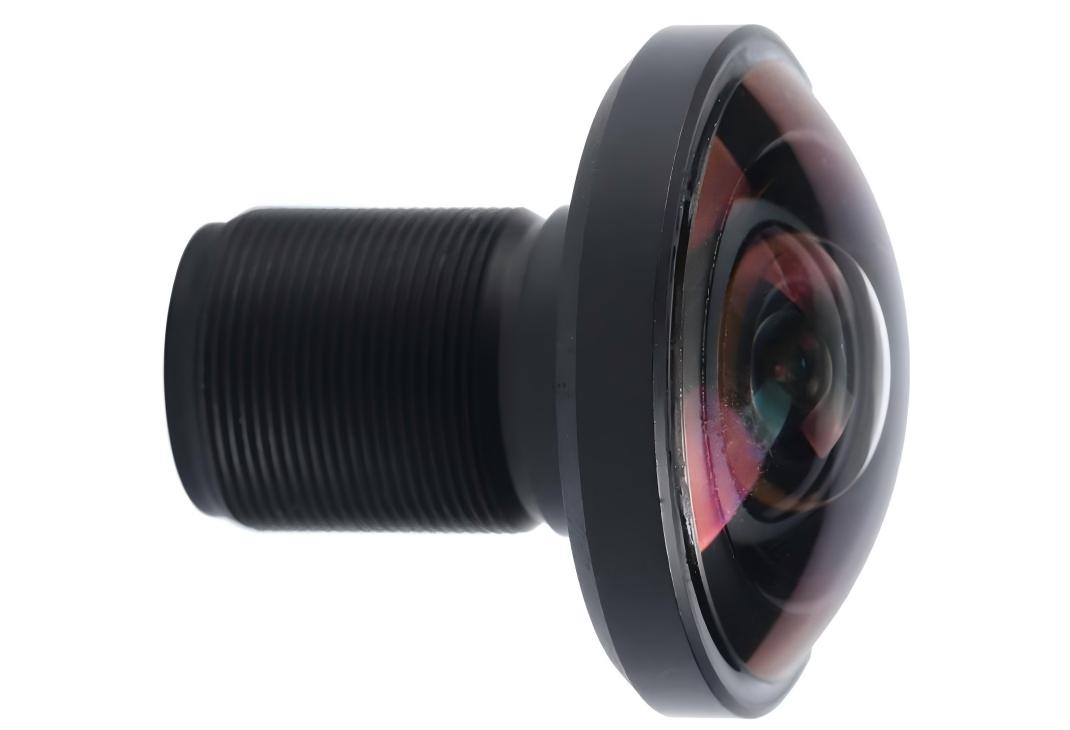
The imaging principle of fisheye lenses
Fisheye lenses fall into two categories: the more common full-frame fisheye, which produces a rectangular image that fills the entire frame without corner vignetting; and the circular fisheye, which offers a field of view exceeding 180°, producing a circular image where the corners of the frame are completely obscured.
Fisheye lenses have very short focal lengths and wide angles of view, allowing them to greatly exaggerate the sense of perspective in a scene. In images captured with a fisheye lens, straight lines appear curved, except for those passing through the center, which remain straight.
2.Distortion correction of fisheye lens
Fisheye lenses achieve a wide field of view by intentionally introducing significant barrel distortion. While objects at the center of the image retain their shape, other elements—normally straight lines—appear distorted or curved, a characteristic that imposes significant limitations on their application.
For example, in the security field, a fisheye lens can replace multiple ordinary lenses for wide-area surveillance. With a field of view of up to 180º, there are almost no blind spots. Even with just one lens, the person being monitored has almost no way to move or damage the lens without being detected. However, due to image distortion, objects are difficult to identify with the human eye, which greatly reduces its surveillance capability.
For example, in the field of robotics, automated robots are required to collect and identify images of the surrounding scenery in order to take corresponding actions. Using a fisheye lens can improve the acquisition efficiency by 2-4 times, but the distortion introduced makes it difficult to apply conventional recognition software.
Therefore, we need a way to process images captured by fisheye lenses. One approach is to perform recognition directly on the raw image—for instance, using an algorithm to locate the sun.
However, because distortion causes the characteristics of an object to vary depending on its position, this method significantly increases the software’s computational load and makes the recognition of complex shapes difficult.
Consequently, the standard practice today is to apply a series of transformations to correct the distortion and obtain a normalized image, which is then used for recognition.
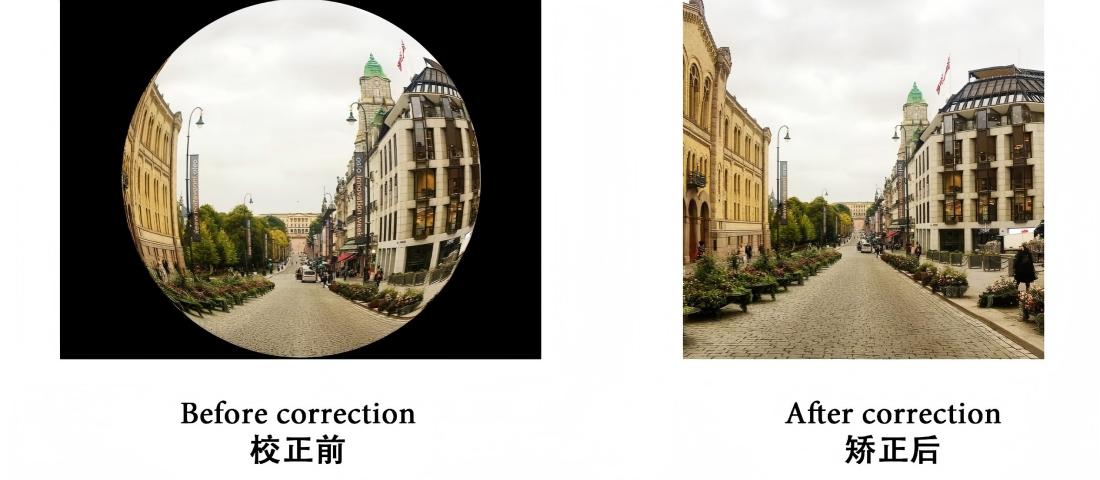
Distortion correction diagram of fisheye lens
3.The relationship between fisheye lens image height and the sensor
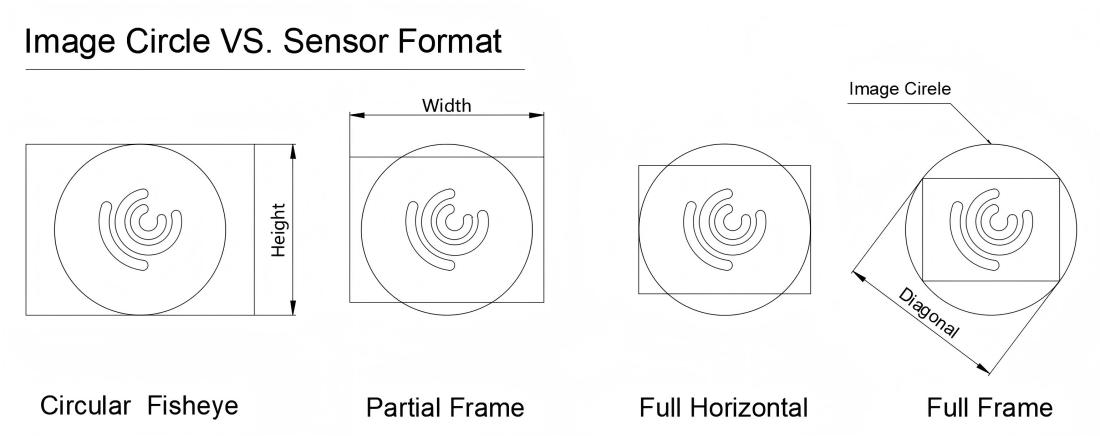
Imaging pattern diagram of a fisheye lens
Currently, fisheye imaging primarily uses vertical incision and top/bottom cropping.
4.Applications of fisheye lenses
Fisheye lenses have a wide range of uses and are very useful for shooting large-scale scenes at close range, and can easily produce visually impactful images. For example, when shooting landscapes, it can make the picture appear more imposing and spacious; and when shooting in a narrow indoor environment, it can also create the effect of a seemingly spacious space.
However, because the field of view of a fisheye lens far exceeds that of the human eye, the resulting photos often convey a highly exaggerated and surreal impression—though this frequently yields unique, imaginative, or intriguing visual effects.
Because the front lens element of a fisheye lens protrudes, it is impossible to install a filter on it like a regular lens. Fisheye lenses typically address this issue by incorporating built-in filters; the photographer can use a filter-switching ring on the lens to rotate the desired filter into the optical path according to shooting requirements.
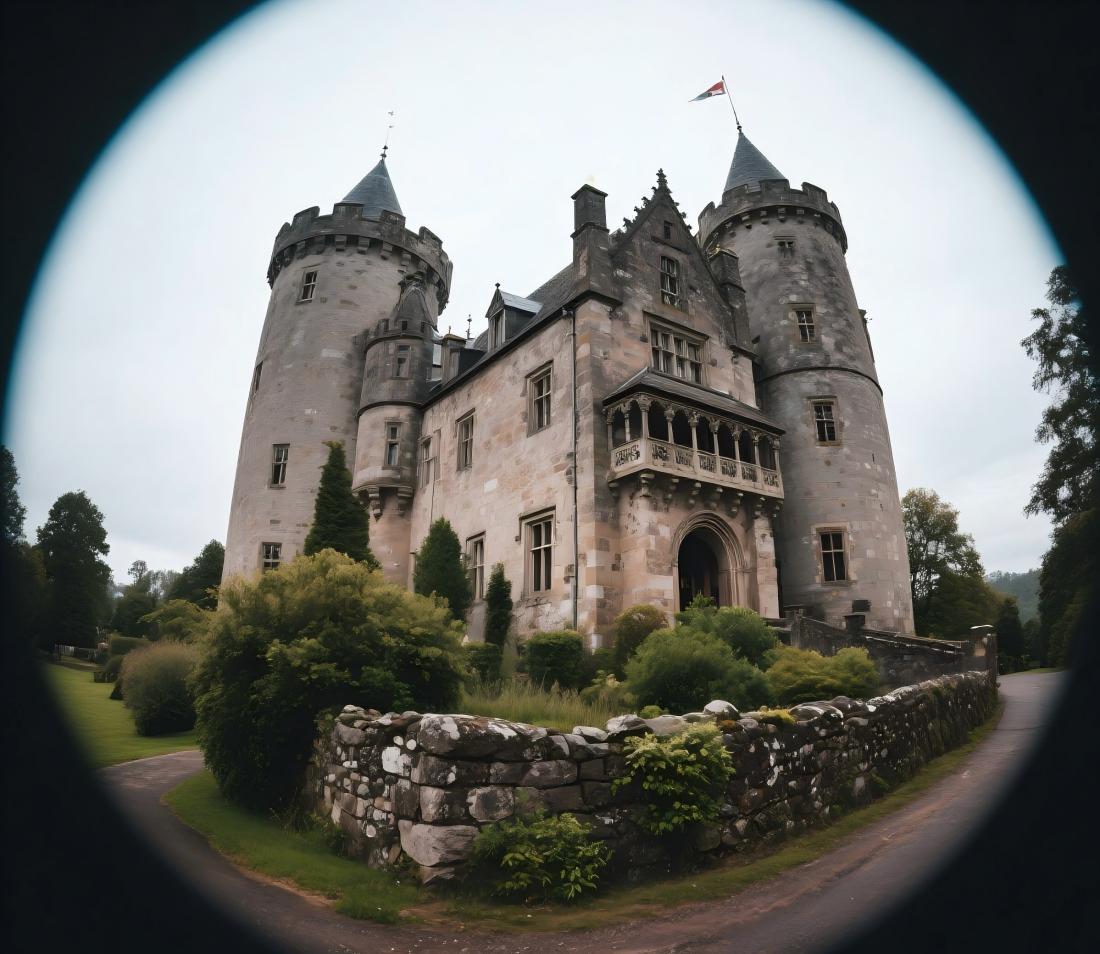
Application examples of fisheye lenses
If you don’t want the distortion from the fisheye lens to affect the balance of the image, you can choose to shoot a relatively symmetrical scene, which will make the image look much more pleasing.
In recent years, fisheye lenses have been increasingly applied in the field of wide-angle imaging, including in military operations, surveillance, panoramic simulation, and dome projection.
Compared to other systems, fisheye lenses offer advantages such as light weight and compact size, though they also present the challenge of requiring aberration correction.
Post time: Oct-20-2026


