
The principle of Time-of-Flight (ToF) is to calculate distance by emitting infrared light and measuring its round-trip time. Strong light (such as direct sunlight, spotlights, etc.) will generate a lot of background light, which will interfere with the echo signal of the emitted light and cause the ranging to fail.
For example, strong sunlight contains abundant near-infrared components, which can enter the receiver of a ToF sensor as background noise. This may drown out the weak modulated light signal reflected back from the target, leading to a decrease in the signal-to-noise ratio (SNR), thereby causing measurement errors, data jumps, or even failure.
To ensure that ToF lenses work stably in strong light environments, a multi-layered and multi-dimensional comprehensive protection strategy is needed. The core ideas are noise suppression, signal enhancement, and dynamic adaptation to the environment. Let’s take a look at the core processing methods:
1.Strong light suppression at the optical level
The key to preventing interference from intense light is limiting the amount of background light entering the ToF sensor. In the solar radiation spectrum, the radiation intensity near 940 nm is significantly lower than in the 850 nm region, inherently providing better resistance to sunlight interference.
Therefore, when designing a lens, a light source with a wavelength of 940nm can be selected first, as it performs more stably under natural light. Secondly, a narrowband filter whose center wavelength is precisely matched to the light source can be installed in front of the lens sensor.
This filter only allows light within a specific wavelength range to pass through, and can filter out more than 90% of sunlight and stray light, greatly improving the optical signal-to-noise ratio.
In addition, installing a lens hood in front of the lens can effectively reduce ambient light from the side from entering the receiver. At the same time, ensuring precise matching between the receiving field of view (FOV) and the transmitting field of view (FOI) can further reduce stray light interference.

ToF lenses require strong-light suppression at the optical level
2.Improve signal strength
Optimizing the optical design and employing a large-aperture lens can increase light intake and improve the signal-to-noise ratio. Additionally, within the limits of eye-safety standards, a high-power laser transmitter can be used to boost the return signal strength and counteract the swamping effect of ambient light.
3.Sensor and circuit anti-interference
ToF sensors are extremely sensitive to electromagnetic interference; electromagnetic noise in strong light environments may be coupled through the circuit. Specialized ToF sensors featuring high dynamic range or anti-blooming capabilities can be employed to prevent pixel saturation caused by intense light.
Incorporating background light cancellation technology into the sensor readout circuitry allows for the real-time subtraction of background charges generated by ambient light. Additionally, using optical isolators or mechanical isolation between the light source and the optical receiver path can prevent optical signals from directly coupling into the circuitry.
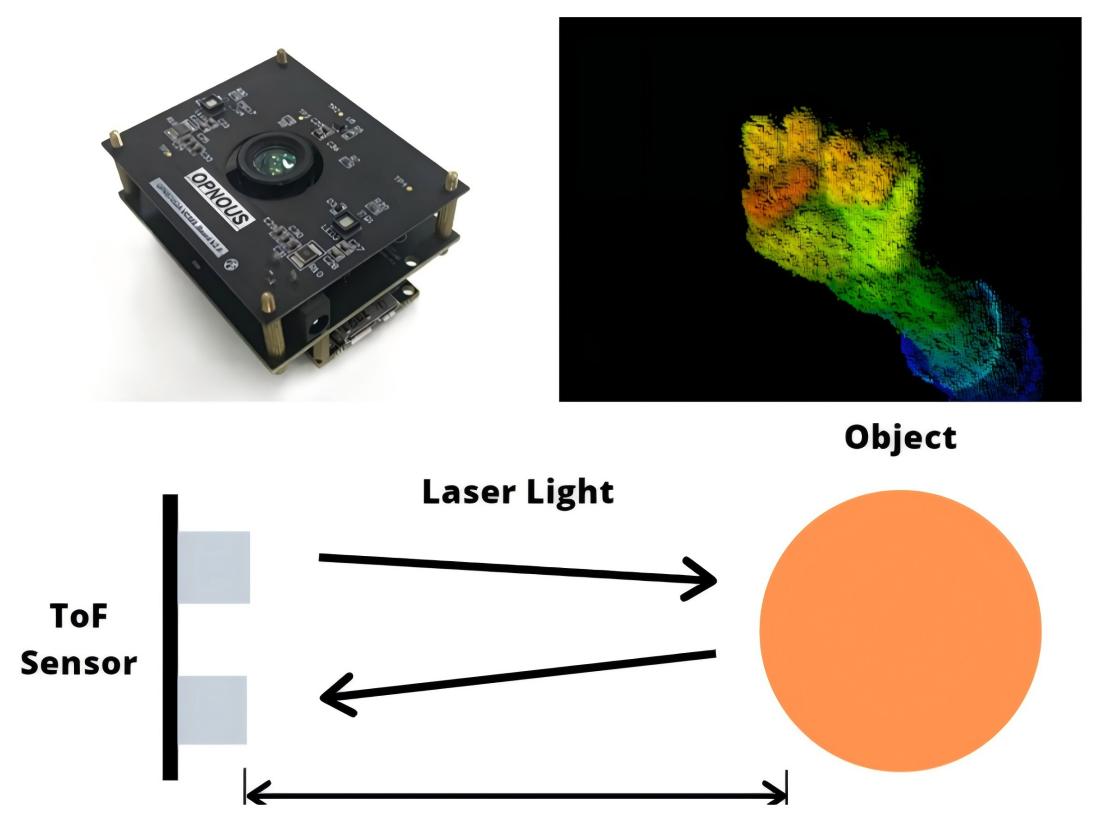
ToF sensors are extremely sensitive to electromagnetic interference
4.Algorithm and modulation optimization
Even if hardware-based shielding is imperfect, software algorithms can further suppress residual noise. During signal processing, the sensor rapidly alternates between capturing data for “signal plus background light” and “background light only”; algorithms then eliminate the background light to extract a relatively clean, valid signal.
Algorithmic identification enables automatic adjustments—such as fine-tuning the modulation frequency upon detecting same-frequency interference (e.g., from another ToF device)—to disrupt the synchronization of the interfering signal.
By analyzing the photon time-distribution histogram, noise photons that do not match signal characteristics can be identified and discarded, retaining only the valid signal peaks.
ToF depth data is fused with data from other sensors, such as RGB cameras and IMUs. When ToF performance degrades under extreme lighting conditions, the system can rely on data from other sensors for compensation or cross-validation, thereby achieving redundancy and fault tolerance to ensure the stability of the overall perception system.
At the same time, the system monitors ambient light intensity in real time and dynamically adjusts laser power and sensor integration time; for instance, it can automatically increase power or shorten integration time under strong light conditions to prevent overexposure.
Furthermore, the use of advanced modulation techniques—incorporating complex modulation waveforms and multi-sample averaging—enhances both interference immunity and measurement accuracy.
Using methods involving algorithms and modulation optimization
5.System integration and environmental adaptation
High temperatures can exacerbate noise. Good heat dissipation design can ensure the stable performance of lasers and sensors. A well-designed lens hood or structure can also reduce the amount of direct strong light entering the lens.
The system features automatic detection and mode switching; when ambient light intensity exceeds a threshold, it can automatically reduce the ranging frequency or switch to a higher-power emission mode. Since intense light and temperature fluctuations can cause system parameter drift, periodic calibration is essential to maintain ranging accuracy.
In summary, by using a multi-dimensional combination of hardware and software protection methods, ToF lenses can maintain stable ranging in strong light environments and keep errors within an extremely low range.
Post time: Aug-04-2026


