
As a non-destructive testing tool, industrial endoscopes have become a key tool for ensuring safety and compliance in the food processing industry due to their non-destructive, high-definition, and flexible detection capabilities.
Essentially, they solve the blind spot problem in traditional equipment maintenance by using the lens as a visualization tool.
Let us now take a closer look at the key application scenarios for industrial endoscope lenses in the food processing industry:
1.Equipment internal cleanliness inspection
Food processing equipment—such as mixers, grinders, blenders, and slicers—features complex internal structures, making it difficult for traditional cleaning methods and visual inspections to reach every hidden corner.
Industrial endoscopes can penetrate deep into equipment to inspect for residual food particles, caramelized protein layers, starch films, scale, or potential microbial contamination, as well as for rust, wear, or damage to components.
Timely detection and cleaning or maintenance can prevent cross-contamination of products and maintain the hygiene and cleanliness of equipment.
2.Food packaging equipment inspection
The sealing performance, cleanliness, and operational status of food packaging equipment directly impact shelf life and safety. Industrial endoscope probes allow for in-depth inspection of packaging machinery, enabling the timely detection of minute defects or residues that could compromise seal integrity, thereby enhancing packaging safety and extending product shelf life.
For example, the 360° panoramic lens of an industrial endoscope can inspect the heat seals, molds, and pressure rollers of a packaging machine, identify micron-sized bubbles, cracks, and inclusions, and reduce packaging breakage rates and leakage risks.
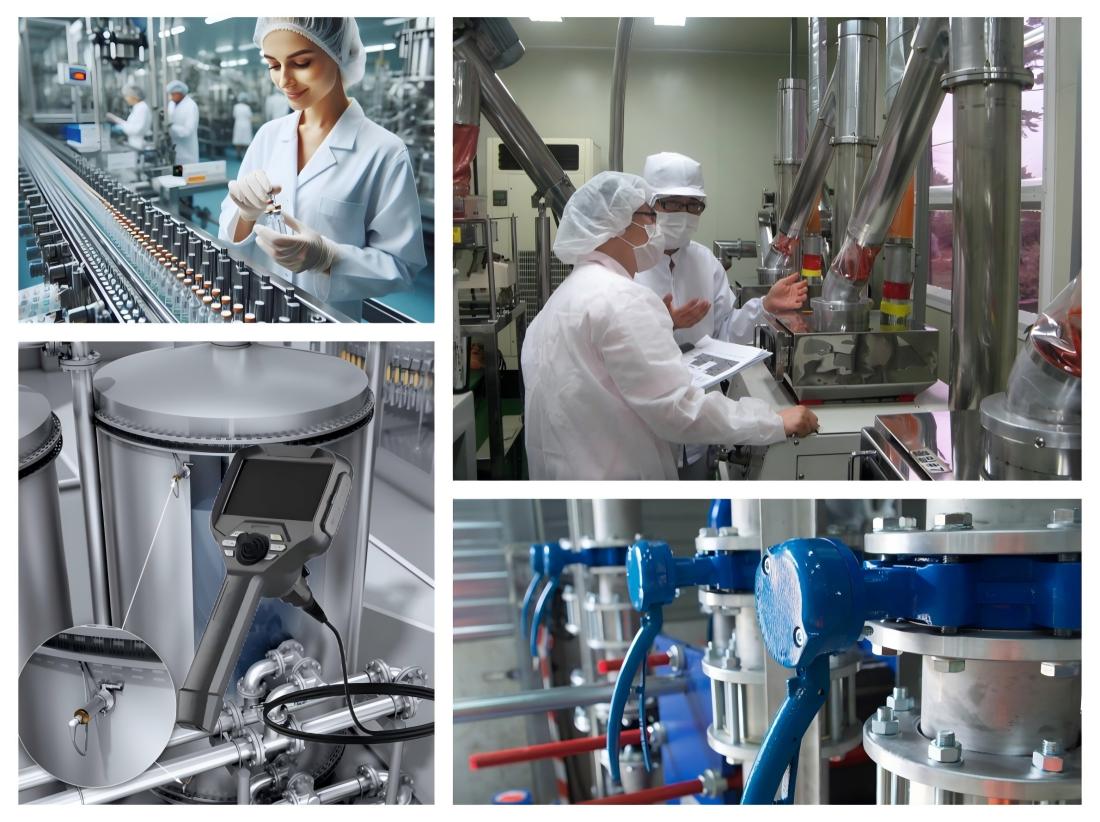
Industrial endoscope lenses are commonly used for inspecting food packaging equipment
3.Production equipment integrity inspection
Integrity checks of food production equipment are also important. Using industrial endoscopes, reaction vessels, storage tanks, pipe walls, and welds can be inspected without disassembling the equipment, effectively preventing hygiene and safety issues caused by welding defects or internal contamination.
4.Sanitary monitoring of conveyance pipelines
Pipelines used for transporting liquids or powders in food production are typically long, narrow, and feature numerous bends, making comprehensive inspection via traditional methods impossible.
Industrial endoscope probes can reach every corner of the pipeline to inspect the integrity of internal coatings and weld quality, as well as check for issues such as buildup, blockages, corrosion, rust, or residual contaminants, thereby ensuring a sterile and smooth transport process. For example, in dairy production, industrial endoscopes can detect sediment and bacterial growth in milk delivery pipelines.
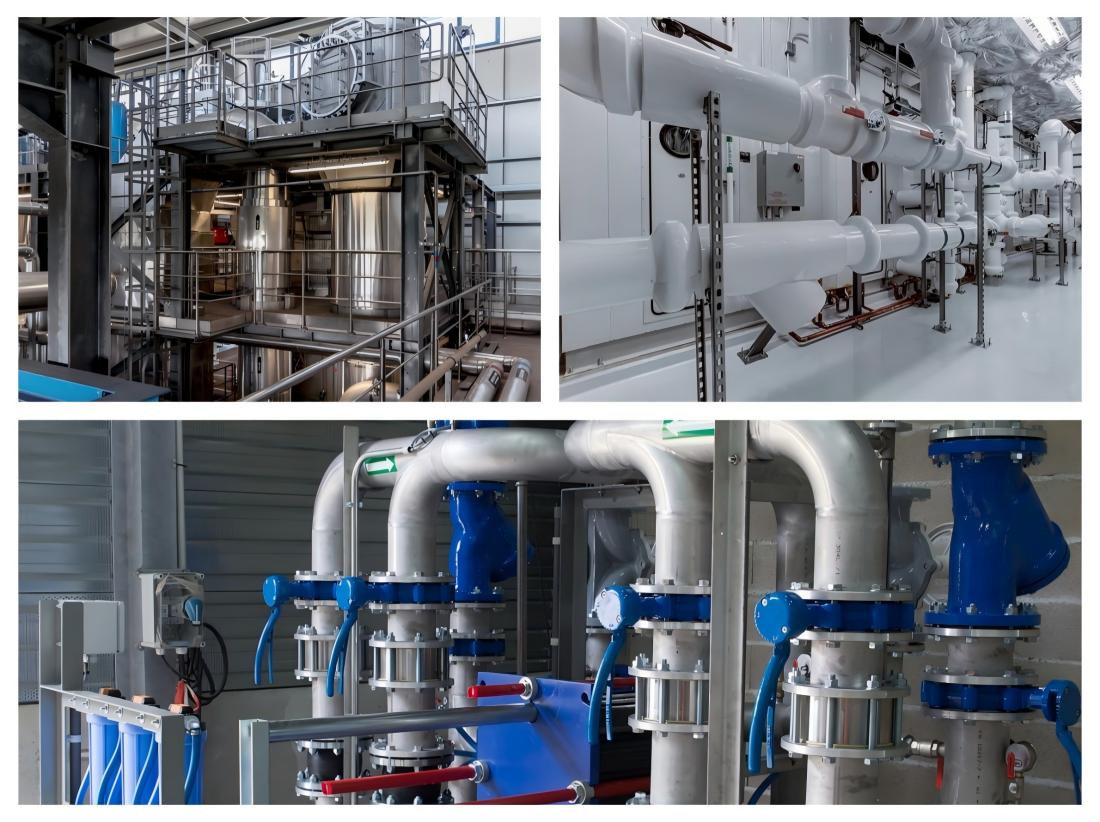
Industrial endoscope lenses are also used for the sanitary monitoring of pipelines
5.Equipment maintenance and fault diagnosis
Industrial endoscopes are also used for long-term equipment maintenance and diagnostics, especially during annual inspections. They can be used to check the wear and tear of internal transmission components in large equipment and to perform internal inspections on packaging equipment in order to detect and address defects that may affect the equipment’s sealing performance in advance, thereby extending the product’s shelf life.
6.Production process and quality control
In food production, industrial endoscope lenses are utilized for in-line quality control, enabling real-time observation of the processing environment and product status. They allow for the monitoring of various stages to ensure compliance with standard operating procedures, facilitating the timely detection and resolution of issues, thereby enhancing production efficiency and product quality.
For example, industrial endoscopes can monitor the sediment in liquid delivery pipelines such as milk in real time, and can be used to check in real time whether there are residues inside agitators or mixers that cannot be removed by regular cleaning.
Industrial endoscope lenses are also used in production processes and quality control
In addition, there are certain precautions to be taken when using industrial endoscopes for related inspections:
1)Strict disinfection before use: The endoscope’s probe and insertion tube must undergo rigorous disinfection and cleaning prior to use to prevent cross-contamination of the food production line.
2)Standardize personnel operation: Personnel using endoscopes should receive professional training and be familiar with the operation methods of the equipment and food safety and hygiene standards.
3)Regular equipment calibration and maintenance: It is necessary to regularly calibrate and maintain industrial endoscope equipment to ensure image quality and the reliability of detection.
4)Detailed recording of inspection results: Results from every quality inspection must be recorded in detail and archived to establish traceable quality records, facilitating future retrieval and periodic maintenance analysis.
In summary, industrial endoscope lenses offer high-resolution imaging and flexible guidance capabilities, making them ideal for inspecting clean pipelines in confined spaces and with complex structures.
By enabling non-destructive inspection, industrial endoscopes effectively prevent material residue and microbial growth, helping food processing enterprises meet stringent food safety standards and enhance production efficiency.
Post time: Aug-28-2026


