
The quality of textile fabrics directly determines the value of the end product, and fabric quality inspection is a key step in quality control during textile production. In textile manufacturing, fabric defect inspection has long relied on manual visual inspection.
However, manual inspection is not only inefficient and prone to subjective error, but also entails high labor and management costs, and it is difficult to guarantee a 100% pass rate. As the textile industry moves toward high speed and automation, the traditional manual inspection model can no longer meet the demands of modern production.
Relying on machine vision technology, using high-precision lenses and intelligent algorithms to replace the human eye has become the mainstream direction for upgrading the textile industry. In actual deployment, however, many projects focus on camera resolution and algorithm models while overlooking a more fundamental element: the lens.
Taking the ChuangAn Optoelectronics CH3645 series lens as an example, this article briefly describes the application of low-distortion, large-depth-of-field lenses in fabric inspection.
I. Special Imaging Challenges in Fabric Inspection
1. Characteristics that require special attention in fabric inspection
Fabric inspection differs from ordinary part appearance inspection. Its operating conditions are more complex, and several key characteristics require special attention:
1) Wide product web. On a typical textile production line, the width of the fabric may range from several hundred millimeters to one or two meters. Completing full-width inspection without stopping the line requires the lens to cover a sufficiently large field of view while preventing a severe drop in image quality at the edges.
2) Many defect types and large differences in scale. Fabric defects include broken warp ends, broken weft picks, holes, oil stains, thick and thin places, slubs, and frayed edges. These defects differ completely in size, shape, and contrast: some are large-area color anomalies, while others are breaks in a single yarn. If the selected lens lacks sufficient resolving power, fine defects are highly likely to be missed.
3) Fabric is not perfectly flat. This is an easily overlooked problem. Even with tension control, the fabric surface still has slight undulations and wrinkles. If the lens has insufficient depth of field, the areas of the fabric that deviate from the focal plane will be out of focus, and the originally clear fabric texture will become a blurred patch of color, causing the algorithm to fail.
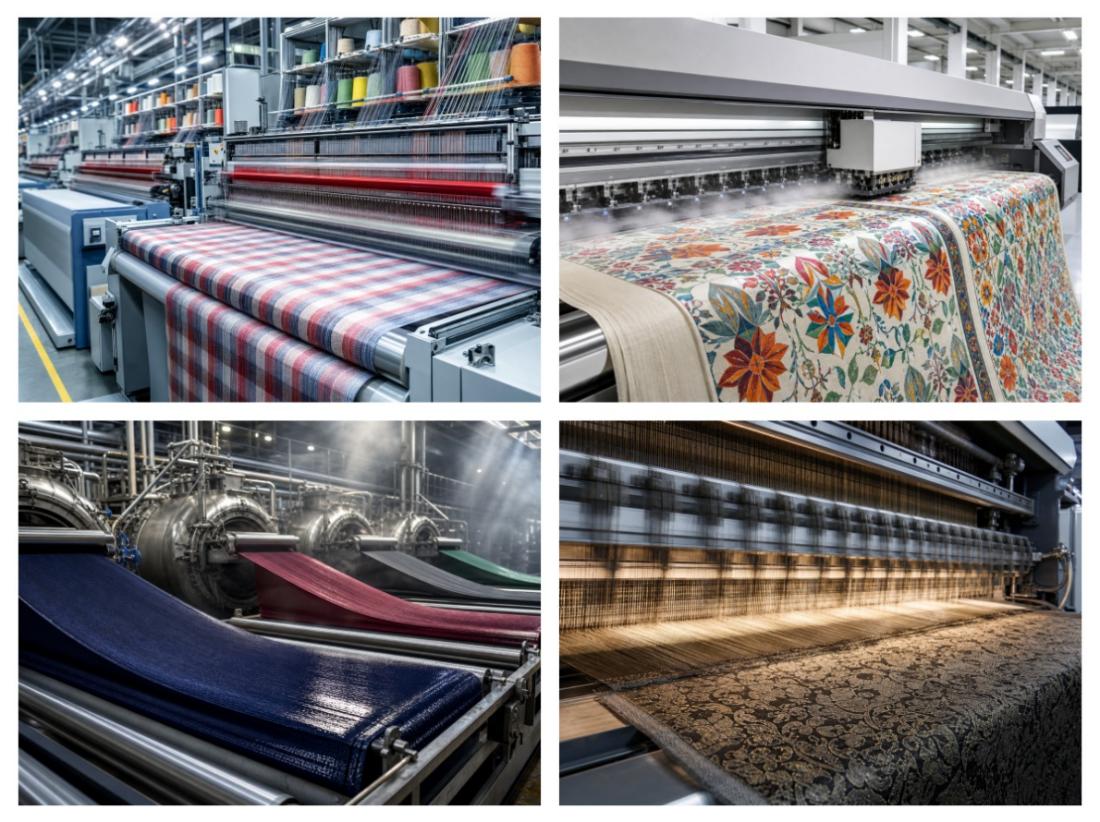
Key characteristics to focus on during fabric inspection
2. Current pain points in machine vision fabric inspection
In the textile and dyeing industry, fabric quality inspection is gradually shifting from manual fabric inspection to fully automated machine vision. A single broken warp end, a single defect point, or a single color deviation point on the fabric can directly affect the grade and selling price of the finished product.
When fabric is fed continuously along the production line, the material undergoes slight vertical vibration and minor surface undulations, and the system must reliably identify fine defects such as broken yarns, skipped yarns, holes, stains, knots, and weft skew.
Whether a machine vision system can see clearly and accurately depends largely on the imaging quality at the front end, and the lens is precisely the first gate that determines imaging quality. If the lens is not selected appropriately, a series of problems can easily arise:
1) Distortion interferes with defect localization. Lens distortion bends the warp and weft lines of the fabric, leading to inaccurate weft-skew measurement and shifted defect coordinates. This increases the correction cost of the algorithm and may even cause false or missed detections.
2) Insufficient depth of field causes local defocus. Fabric often warps slightly and vibrates vertically. If the depth-of-field range of the lens is insufficient, local blurring readily occurs in the image, and fine yarn defects cannot be clearly identified.
3) Edge illumination falloff. Insufficient brightness at the corners of the lens field of view darkens the texture on both sides of the fabric width, which can reduce the ability to identify defects in corner areas.
4) Insufficient resolving power misses tiny defects. Fabric defect points are very small in size. If the resolution of the lens is insufficient, texture details are easily lost, making it difficult to identify fine yarn breaks and small holes.
3. Core Lens Requirements of the Fabric Inspection Scenario
Based on the pain points above, the fabric inspection scenario imposes several core requirements on the lens:
1) Low distortion. Fabric is wide and moves fast. If the edge imaging of the lens shows obvious barrel or pincushion distortion, the entire image will undergo geometric deformation, directly affecting the coordinate accuracy of defect localization.
2) Large depth of field. The fabric surface is not perfectly flat. Tension fluctuations and mechanical vibration both change the distance between the fabric surface and the lens. A large-depth-of-field lens keeps defects within the visible range of the lens at all times and ensures clear imaging.
3) High resolution. Fine defects on the fabric surface, such as fly lint, broken yarns, and pin holes, place high demands on lens resolution. Pixel-level reproduction of texture details is the prerequisite for stable recognition by the back-end inspection algorithm.
In addition, the fabric inspection scenario also requires the lens to provide excellent close-range imaging capability and environmental adaptability, so that it can cope with the complex production line conditions in a workshop.
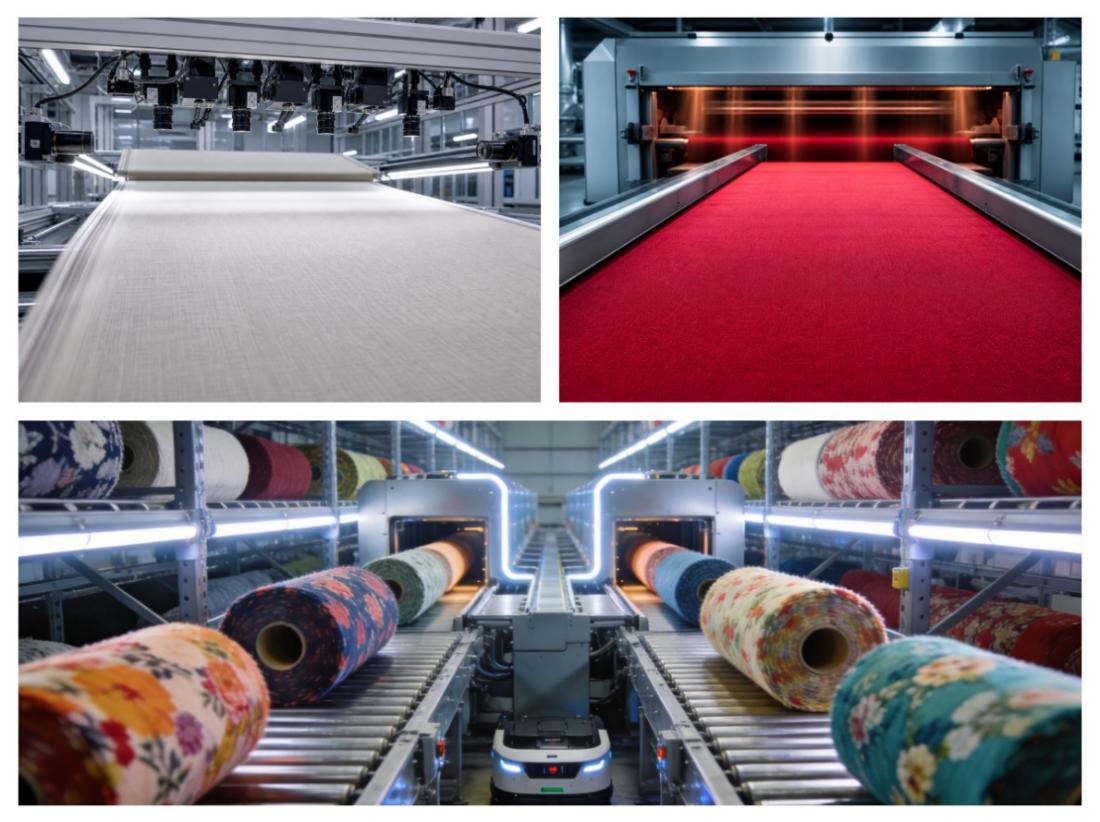
The core requirements of lenses in fabric inspection scenarios
II. Core Advantages of the CH3645 Series Lens for Fabric Inspection
The ChuangAn Optoelectronics CH3645 series lens is a low-distortion fixed-focal-length (prime) industrial lens with a 1/2.3-inch sensor format design and 4K resolution, and is available with multiple mounts (M12, C, and CS). Its parameters closely match the visual inspection requirements of fabric:
1. Ultra-low distortion design (TV Distortion < -0.5%)
The ultra-low-distortion design restores the true texture of the fabric. The TV distortion of this series is less than -0.5%, which greatly reduces geometric deformation in the image, reproduces the warp and weft lines of the fabric faithfully, makes weft-skew measurement and defect localization more accurate, and reduces the amount of software distortion correction required in post-processing.
2. 4K resolution for high-definition detail
The CH3645 series lens offers 4K resolution and is designed for 1/2.3-inch sensors, so it is compatible with today’s mainstream 4K industrial cameras. In fabric inspection, high resolution delivers a higher pixel density, making it possible to capture extremely fine defects on the fabric surface, such as tiny oil stains, holes, and pulled yarns. This provides ample detail features for the back-end image recognition algorithm and effectively reduces the missed-detection rate.
3. Short focal length with a medium-to-small aperture, conducive to a large depth of field
This series has a focal length of 4.55 mm and an aperture of F3.2, a typical combination of a short focal length plus a medium-to-small aperture and a classic optical configuration for achieving a large depth of field. At typical industrial inspection working distances, it provides a comfortably wide depth-of-field margin.
Its minimum focusing distance is 0.1 m, which allows flexible close-range installation and accommodates changes in the distance between the fabric surface and the lens. Even when the fabric floats vertically by several millimeters and warps during feeding, it remains within the sharp imaging range, and texture and defect details are not lost.
4. High relative illumination and a wide field of view
This series offers relative illumination greater than 69%, so brightness falloff from the center to the corners of the image is small. Its field of view is H71°/V50°/D82°, so a single camera can cover a wide web, and the texture at both the left and right ends of the fabric width is equally clear and bright, solving the problem of dark corners at the edges of the roll material.
5. Industrial-grade construction with strong compatibility and adaptability
This series is available with multiple mounts (M12, C, and CS) and is compatible with the vast majority of industrial cameras, greatly lowering the selection threshold and the replacement cost for users. Textile mills commonly experience temperature fluctuations, dust, and vibration.
This series has an operating temperature range of -20 °C to +45 °C and a storage temperature range of up to -20 °C to +85 °C, so it can adapt to the temperature conditions of the vast majority of industrial sites.
The core advantages of lens-adapted fabric inspection
III. Typical Application Scenarios
Typical application scenarios for low-distortion, large-depth-of-field lenses, as represented by the CH3645 series, in fabric inspection are as follows:
1. Inline fabric surface defect inspection system
This inspection system is mainly aimed at various textile fabrics running at high speed, detecting macroscopic and microscopic defects such as broken warp ends, broken weft picks, holes, oil stains, pulled yarns, knots, and slubs. The 4K high resolving power of the lens ensures that tiny defects are captured, while the wide field of view enables wide fabric to be captured in a single pass, reducing the number of cameras used.
The low-distortion design ensures accurate defect localization. With this series of lenses, an inline fabric inspection system can be built to replace manual fabric inspection on a large scale, increasing the defect detection rate and reducing the false-detection rate.
2. Analysis of fabric weave structure and texture
In addition to high-speed inline inspection on the production line, this series of lenses can also be used while the line is stopped to analyze the weave structure of sample fabrics and finished fabrics, checking metrics such as warp and weft density, weaving defects, texture uniformity, and yarn twist.
With high-resolution imaging at close range and low distortion keeping the warp and weft yarns straight and level, the algorithm can count automatically and accurately, enabling high-precision automated measurement of fabric density and providing data support for textile process optimization.
3. Image quality inspection of dyed and printed fabric
For dyed and printed fabrics, in addition to conventional defects, the system can also check the registration accuracy of printed patterns and problems such as missing print, misprint, color difference, and poor color registration.
Low-distortion imaging ensures that printed patterns are not stretched or deformed at the edges of the image, safeguarding registration inspection accuracy, precisely identifying printing defects and color differences, and increasing the yield of printed products.
4. Precision measurement of fabric width and length
Thanks to its low-distortion imaging characteristics, this series of lenses enables reliable measurement of fabric length and width and is also used for real-time width monitoring, length metering, and edge straightness inspection.
Extremely low distortion is the core advantage in this scenario: it keeps the pixel scale at the edges of the image consistent with that in the center, so highly accurate physical dimension measurements can be obtained without a complex distortion correction algorithm.
The application of low-distortion, large-depth-of-field lenses in fabric inspection is essentially a precise match between optical performance and inspection conditions.
Industrial lenses represented by the CH3645 series rely on low distortion to ensure the geometric fidelity of the image, on a large depth of field to ensure imaging stability, and on high resolving power to ensure defect visibility. Working together, these three factors provide a reliable optical foundation for machine-vision-based fabric quality inspection.
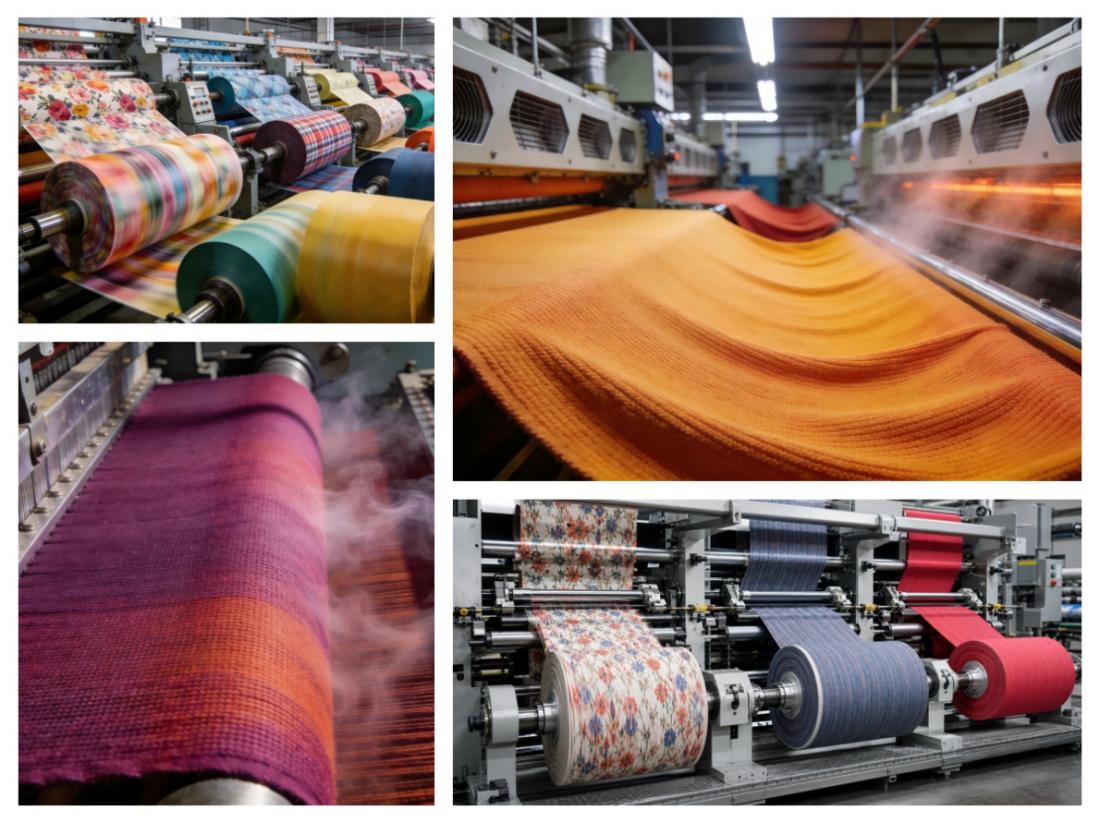
Application scenarios of low distortion and large depth of field lenses in fabric inspection
IV. On-Site Precautions for Using the Lens
For the textile workshop environment, the following points must be noted when using this series of lenses:
1. Dust protection. Textile workshops contain a great deal of cotton fly and dust, which readily adhere to the front lens group and affect imaging. It is recommended to install a protective glass in front of the lens or to clean it periodically.
2. Vibration resistance. High-speed looms or fabric inspection machines generate vibration, which may loosen the lens or shift focus. Use lock nuts or thread-locking adhesive when mounting the lens, and check the tightness of the fastening regularly.
3. Temperature and humidity control. The CH3645 series has an operating temperature of -20 °C to +45 °C and a storage temperature of -20 °C to +85 °C, which meets the requirements of the vast majority of textile workshop environments. In environments with severe temperature differences, however, precautions must be taken against condensation forming inside the lens.
4. Lens cleaning procedure. When cleaning, use dedicated lens tissue or a lint-free cloth, moisten it with a small amount of anhydrous ethanol or lens cleaning solution, and wipe gently from the center of the lens outward. Never scrape the lens surface with a hard object, especially on plastic lens elements (this series uses hybrid glass-plastic lenses). When the lens is not in use for a long period, put on the dust cap and store it in a dry, light-free environment.
Post time: Nov-24-2026


