
As society continues to advance in digitalization and intelligence, anti-counterfeiting identification technology has penetrated into many fields, including finance, government services, transportation, and retail.
It is widely used in scenarios such as financial document verification, anti-counterfeiting of high-end consumer goods, authentication of identity documents, and authentication of artworks, and it covers high-frequency applications such as document recognition, ID card verification, barcode scanning, palmprint and palm-vein recognition, and QR code payment.
Against the backdrop of the rapid adoption of machine vision, anti-counterfeiting identification scenarios of all kinds are imposing higher and more stringent requirements on imaging lenses.
A lens must not only deliver clear and sharp imaging quality but also maintain stable identification performance under complex lighting conditions; it must ensure image quality over a large field of view while also meeting the requirements of high-definition imaging in broadband spectral environments.
Taking the CH1962B low-distortion IR corrected lens from ChuangAn Optics as an example, this article analyzes the advantages and application value of such lenses in anti-counterfeiting identification scenarios.
I. Core Requirements of Anti-Counterfeiting Identification for Lenses
The mainstream anti-counterfeiting identification technologies today mainly include fluorescent anti-counterfeiting, infrared anti-counterfeiting, QR code/barcode recognition, and image feature recognition.
Among them, fluorescent anti-counterfeiting uses ultraviolet light of a specific wavelength to excite anti-counterfeiting ink to emit light, and verification is performed by observing the color and pattern of the emitted light; infrared anti-counterfeiting exploits the absorption or reflection characteristics of specific materials in the infrared band to read hidden information invisible to the naked eye; and QR code and barcode recognition as well as image feature recognition rely heavily on high-resolution, low-distortion visible-light imaging systems to extract fine textures and geometric features.
Anti-counterfeiting identification equipment must routinely process a large amount of image information: microtext on documents, holographic patterns on ID cards, traceability QR codes on product packaging, and so on. The objects to be identified vary widely, and the identification environment is not fixed — operating conditions such as natural daylight during the day and infrared fill light at night alternate.
As the first core component in the image acquisition chain, the imaging quality of the lens directly determines the identification result. Once problems such as image distortion, defocus, or chromatic aberration occur, even the most advanced downstream intelligent recognition algorithms cannot compensate for the imaging defects, and identification errors, missed detections, and false detections are very likely to result.
Given the particularity of the application scenarios, anti-counterfeiting identification places extremely stringent technical requirements on optical lenses:
1. Low-distortion design. Anti-counterfeiting identification usually involves carriers such as QR codes, barcodes, microtext, infrared ink, and hidden codes, for which the geometric fidelity of the pattern is critical. Lens distortion causes stretching or compression at the edges of the image and directly affects the feature extraction accuracy of machine vision algorithms; the TV distortion of the lens is therefore usually required to be kept within 1%.
2. Broadband spectral transmission capability. Anti-counterfeiting features cover multiple bands including near-ultraviolet, visible light, and infrared. The lens must provide broadband spectral transmission from near-ultraviolet (e.g., 360 nm) to near-infrared (e.g., 850 nm), with uniform and stable transmittance across all bands, so that multi-band imaging can be achieved without relying on an IR-cut filter and the needs of multimodal anti-counterfeiting detection can be met.
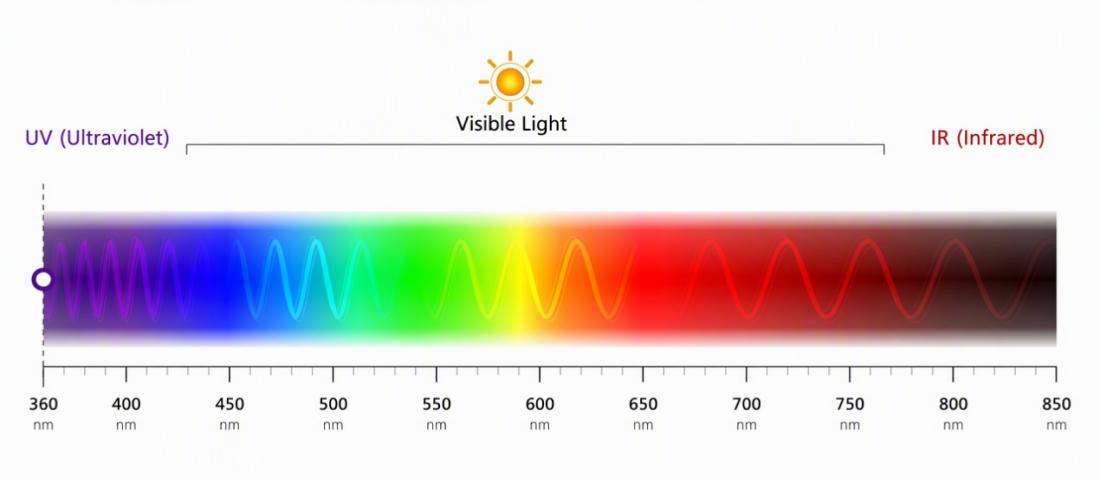
Anti-counterfeiting applications require lenses to have broad spectral transmittance
3. Day/night confocal performance. During multi-band switching verification, if the lens has chromatic aberration, the focal planes of different bands shift, causing image blur after the band is switched and requiring refocusing. A day/night confocal design ensures that the ultraviolet, visible-light, and infrared bands form clear images on the same focal plane, enabling seamless switching.
4. High resolution and high relative illumination. Resolving fine anti-counterfeiting textures requires the support of high resolution, while high relative illumination (>50%) ensures consistent brightness between the edges and the center of the image, prevents edge features from being lost to vignetting, and provides uniform, high-quality input for AI algorithms.
5. Miniaturization and reliability. Portable anti-counterfeiting detection equipment is limited in space and is subject to strict constraints on volume and weight. The lens must achieve high performance within an extremely small size while also meeting the reliability requirements of an industrial-grade temperature range (-10 °C to +55 °C).
II. Core Parameters of the CH1962B for Anti-Counterfeiting Applications
The CH1962B is a low-distortion scan lens developed by ChuangAn Optics with day/night confocal performance, and its core technical parameters fully target the high-end requirements of anti-counterfeiting identification:
1. Low-Distortion Design
Anti-counterfeiting identification depends heavily on the geometric consistency of the image. Excessive lens distortion would stretch or shift features such as card edges, QR codes, and microtext, increasing the difficulty of algorithm correction and even affecting the recognition rate.
The CH1962B uses a precision optical design that keeps TV distortion strictly within -1%, restoring the geometry of anti-counterfeiting patterns to the greatest extent possible and providing machine vision algorithms with distortion-free image input.
2. High-Resolution Imaging
The lens achieves 5-megapixel high-definition imaging on a 1/2.5″ image plane, fully resolving fine anti-counterfeiting textures and ensuring that details such as microtext, laser-engraved QR codes, and latent images are clearly distinguishable, thereby fully meeting the image acquisition requirements of high-precision anti-counterfeiting detection.
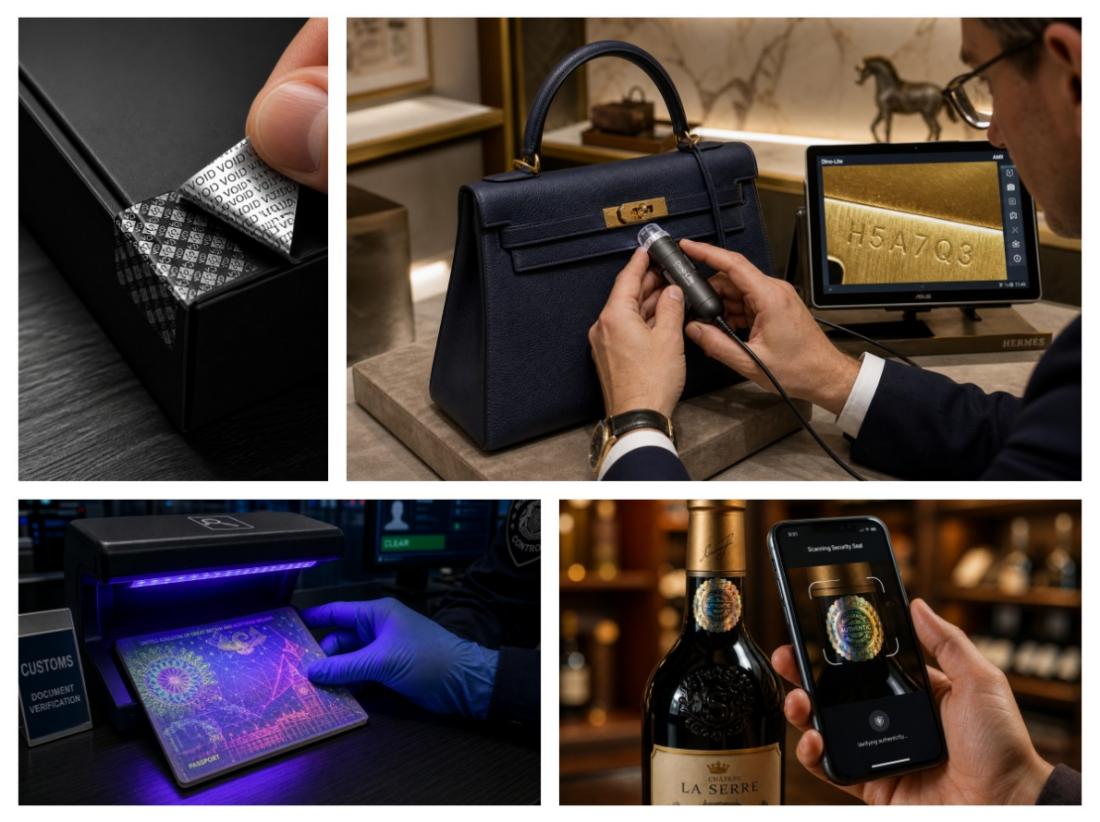
This lens features high-resolution imaging and other characteristics
3. 360–850 nm Broadband Coating
The dedicated coating of the lens covers the UV-A near-ultraviolet band (360–400nm), the entire visible-light band, and the near-infrared band (780–850nm) — three core bands — enabling integrated ultraviolet fluorescence imaging, visible-light imaging, and infrared imaging.
Multi-band anti-counterfeiting verification can be completed without changing lenses, making the lens suitable for scenarios involving multiple types of anti-counterfeiting technology.
4. Day/Night Confocal Design
Through a precise optical design, the lens maintains imaging on the same focal plane in the visible-light, infrared, and ultraviolet bands. Combined with a fixed aperture and a manual focus structure, it keeps the focus consistent between imaging in natural daylight and imaging with infrared fill light at night, so that multi-band seamless switching can be achieved without refocusing. This solves the focusing delay problem in multimodal detection and greatly improves verification efficiency.
5. Large Field of View + High Relative Illumination
The lens provides a wide-angle field of view of 88° horizontal, 57° vertical, and 105° diagonal, allowing a single capture to cover a larger detection area. With relative illumination >50%, brightness falloff at the four corners of the image is small, so texture and ink details remain discernible even when an anti-counterfeiting mark is at the edge of the image.
This avoids the problem of a sharp center but ineffective edges and makes the lens suitable for close-range scenarios requiring precise identification, such as ID cards, documents, and labels.
6. Lightweight and Compact Structure
The lens has an equivalent focal length of 2.97 mm and uses the industry-standard M12×P0.5 mount. Its overall size is small and its weight is light, making it easy to integrate into various portable detection devices such as document cameras, handheld detectors, and security inspection equipment.
III. Advantages of Day/Night Confocal Technology in Anti-Counterfeiting Identification
Built on the mature core day/night confocal design, the CH1962B lens brings notable advantages to anti-counterfeiting identification systems:
1. Compatibility with multi-band anti-counterfeiting on a single unit, simplifying the device architecture. Conventional devices usually require two sets of lenses or a complex focusing mechanism, resulting in a large device volume, a cumbersome structure, and a high failure rate. With a single lens, the CH1962B can perform simultaneous imaging verification of ultraviolet fluorescent anti-counterfeiting, visible-light image anti-counterfeiting, and infrared hidden anti-counterfeiting on the same focal plane, greatly simplifying the device architecture.
2. Improved efficiency of multimodal anti-counterfeiting verification. In high-frequency scenarios such as high-speed scanning inspection, batch ID card verification, and real-time traceability inspection, the multi-band switching of this lens requires no refocusing, avoiding the efficiency loss caused by focusing time. It supports continuous, real-time multimodal verification and meets the needs of large-scale, high-efficiency inspection.
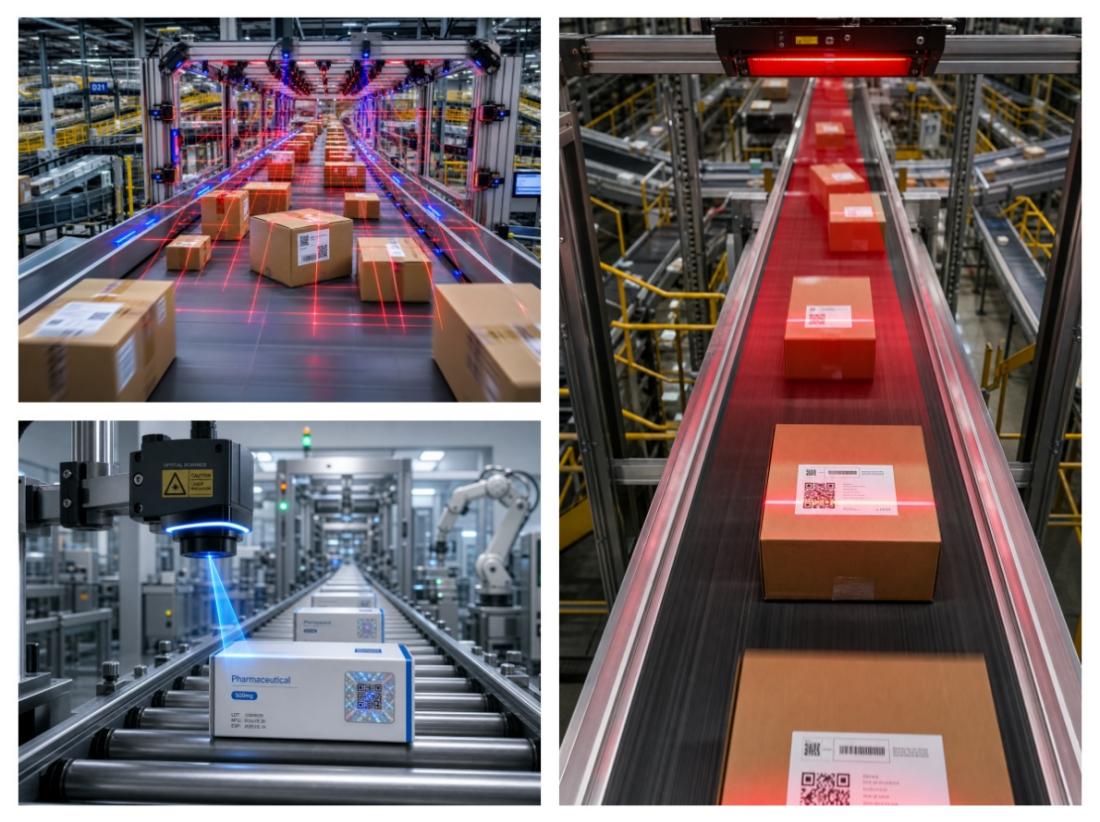
Day and night confocal technology brings significant advantages to anti-counterfeiting identification systems
3. Optimized system integration and cost. Replacing a multi-lens solution with a single-lens solution not only effectively reduces the BOM material cost of the device but also cuts the installation space and weight of the device, making portable anti-counterfeiting detection equipment lighter and easier to use and improving its suitability for end-product deployment.
4. All-weather anti-counterfeiting identification capability. Whether in an indoor visible-light environment or in a darkroom ultraviolet or infrared inspection environment, the lens maintains stable and consistent imaging quality and is unaffected by changes in the lighting environment, providing all-weather, all-scenario anti-counterfeiting identification capability.
IV. Typical Application Scenarios for Anti-Counterfeiting Identification
1. Anti-Counterfeiting Verification of Documents and ID Cards
The CH1962B lens is widely suited to scanning scenarios such as ID document photography and document cameras. Verifying the anti-counterfeiting features of documents such as ID cards, passports, and business licenses, as well as of documents such as banknotes and invoices, requires detail reproduction at both the center and the edges at the same time.
The low-distortion characteristics of the CH1962B ensure that the positional relationships among the security thread, microtext, and watermark at the four corners of an ID card are not distorted, and together with 5-megapixel resolution, it fully meets the sampling density requirements of AI recognition algorithms.
In addition, the 360–850 nm broadband coating design of the lens enables it to acquire surface information of documents in visible light, excite fluorescent anti-counterfeiting patterns in the ultraviolet band, and read hidden anti-counterfeiting information in the infrared band. Multi-band confocal imaging requires no repeated focusing, completing multi-dimensional anti-counterfeiting verification in a single pass.
2. Face and Access Control Verification Terminals
At entrances and exits such as residential communities, office buildings, and industrial parks, the span of lighting between day and night is large. With its 360–850 nm broadband coating working together with an IR-cut filter, the CH1962B leverages its broadband imaging capability to effectively ensure the true skin tone required for color imaging and liveness detection during the day, while switching to the near-infrared channel at night keeps images stable and clear, supporting stable 24-hour unattended verification.
3. Anti-Counterfeiting of Product Packaging and Traceability Labels
In anti-counterfeiting and traceability scenarios for branded goods such as tobacco and alcohol, pharmaceuticals, luxury goods, and cosmetics, traceability QR codes and anti-counterfeiting labels on curved surfaces and corners of product packaging are difficult to identify.
The CH1962B’s 105° ultra-wide-angle field of view, combined with an ultra-close focusing distance of 0.1 m, allows a single capture to fully cover an entire anti-counterfeiting label and packaging markings without repeated framing and focusing. Its ultra-low distortion prevents geometric deformation of QR codes and barcodes, effectively avoiding decoding failures and recognition stalls caused by distortion.
It is suitable for high-speed scanning on production lines and batch traceability inspection, greatly improving the efficiency of product anti-counterfeiting verification.
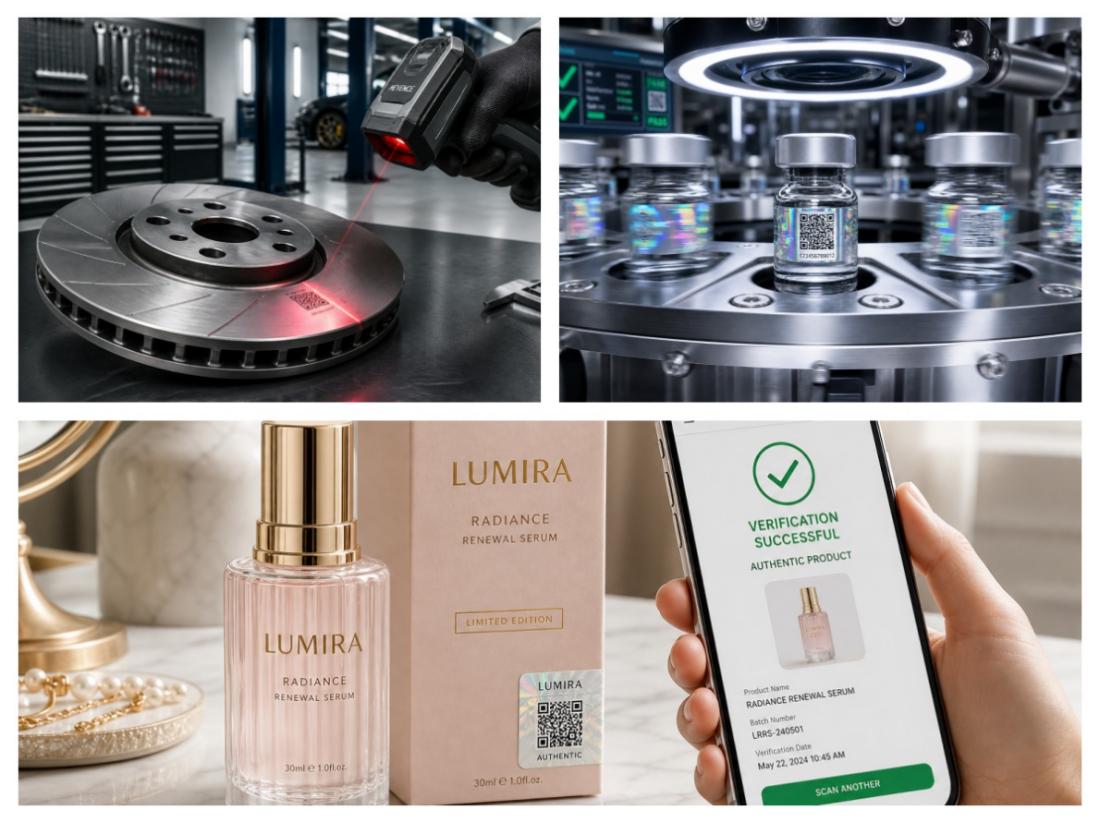
Anti-counterfeiting applications in product packaging and traceability labels
4. Customs and Security Inspection Anti-Counterfeiting
Customs and port security inspection scenarios have stringent requirements for the accuracy of anti-counterfeiting inspection and the portability of equipment. In anti-counterfeiting inspection of goods and identification of hazardous materials markings, the broadband coverage of the lens supports joint multi-band verification, allowing forged markings to be quickly identified.
Its compact and lightweight design facilitates integration into handheld security inspection equipment; the day/night confocal characteristics adapt to switching between dark and bright environments; and the low-distortion design ensures the geometric accuracy of hazardous materials markings, safeguarding the accuracy and stability of inspection.
5. Artwork and Cultural Relic Authentication
Artwork and cultural relic authentication often relies on the detection of fluorescent anti-counterfeiting traces, the analysis of coating textures, and the identification of surface details. The UV-A band transmission capability of the lens can precisely excite fluorescence, and the day/night confocal characteristics ensure that no refocusing is needed when switching to the visible-light band to observe surface details.
At the same time, its high resolution and high relative illumination ensure clear reproduction of coating textures, providing reliable optical data support for professional cultural relic restoration and the authentication of artworks.
In summary, with core features such as low distortion, day/night confocal performance, broadband coverage, high-definition imaging, and a lightweight design, the CH1962B low-distortion IR corrected lens provides a high-quality optical solution for many types of complex anti-counterfeiting identification scenarios, including ID card verification, document scanning, traceability code recognition, access control face verification, customs security inspection, and artwork authentication.
Post time: Nov-27-2026


