
A line scan lens is an optical lens specifically designed for line scan cameras based on line-by-line scanning technology. Its core imaging method involves the sequential acquisition of single-line pixels followed by continuous image stitching. It plays a vital role in the field of machine vision and is widely used across various industrial inspection scenarios.
Line scan lenses are particularly suited for inspecting materials in continuous motion or cylindrical objects, enabling the capture of micron-level defects with ease. Below are several typical application scenarios for line scan lenses in industrial inspection:
1. Electronics manufacturing and semiconductor inspection
In the manufacturing of electronic components and semiconductors, products are characterized by high precision and miniaturization. Inspection accuracy requirements often reach the micron or even nanometer scale. With their advantage of ultra-high resolution, line scan lenses have become core equipment for precision inspection in this field.
For example, in PCB (Printed Circuit Board) inspection, high-resolution line scan lenses can clearly capture defects such as circuit offset, soldering flaws, copper foil peeling, pinholes, and scratches. They accurately identify micron-level circuit errors to ensure the electrical stability of the boards.
In semiconductor wafer manufacturing, line scan lenses perform high-speed, line-by-line scanning of the wafer surface to accurately identify surface defects like tiny scratches and particle contamination, thereby safeguarding chip yield rates.
2. Surface defect detection of metal sheets
In the metal processing industry, line scan lenses are commonly used to detect surface defects in metal films and sheets. Products such as steel plates, aluminum plates, copper foils, aluminum strips, and stainless steel coils are often ultra-long continuous materials (hundreds of meters).
Due to fast production speeds and diverse defect types, traditional manual sampling and area scan inspections are prone to missing defects. Consequently, line scan lenses are the mainstream inspection equipment in this industry.
For instance, on hot-rolling or cold-rolling steel production lines, high-resolution line scan lenses follow the production line to precisely identify defects like roller marks, pits, scratches, bubbles, and uneven color. Simultaneously, they can provide real-time detection of dimensional issues such as thickness deviation, edge burrs, and width inconsistency.
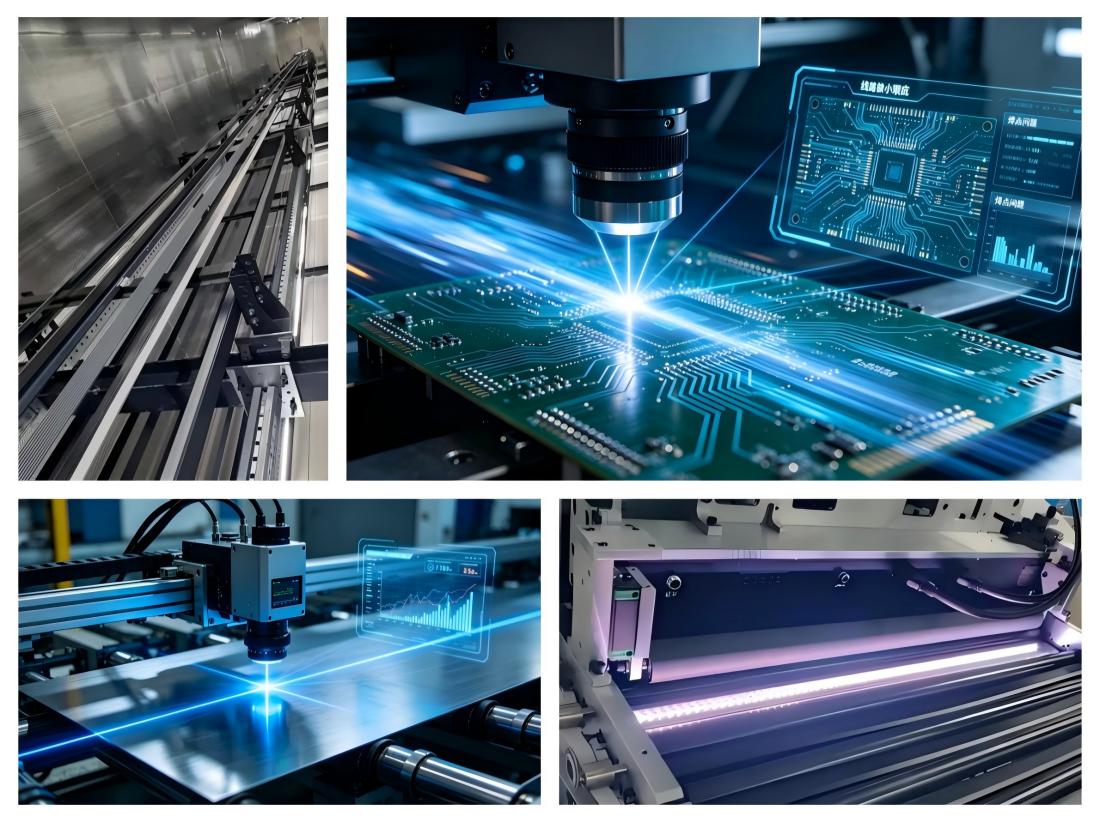
Surface defect detection for metal sheets
3. Printing, packaging, and textile inspection
Products in the textile and papermaking industries—such as fabrics, non-woven materials, paper, and tobacco packaging paper—are all wide-format continuous materials. Surface flaws, color differences, and texture defects are primary quality indicators. Line scan lenses offer natural advantages for high-speed, visualized quality control throughout the process.
In the printing industry, for high-speed roll printing of tobacco packs, medicine boxes, and labels, production speeds can reach hundreds of meters per minute. Inspections target issues like missing ink, registration offset, color difference, dirt spots, and die-cutting deviations.
By scanning along the transmission direction and comparing the results with a standard template, line scan lenses can quickly detect registration errors, missing prints, or uneven ink distribution.
In the textile industry, line scan lenses acquire real-time images of the fabric to precisely identify yarn defects, snags, holes, color inconsistency, and weaving texture errors. They can also identify subtle defects like uneven weight (GSM) or local wrinkles, significantly reducing manual labor intensity and the missed-detection rate.
4. Automotive and precision component inspection
Automotive manufacturing involves numerous complex processes where line scan lenses act as critical “quality inspectors,” used in welding line inspection, component testing, and tire surface defect detection.
For example, on body welding lines, line scan lenses scan along the weld seam trajectory to detect in real-time whether the weld is full or if there are issues like missing or false welding, ensuring the structural safety of the vehicle. For car bodies and long decorative trims, these lenses perform full-field detection of scratches, color differences, dents, and impurities on large paint surfaces.
Beyond flat and long materials, line scan lenses can be paired with rotating stations and specialized fixtures to achieve “unrolled” inspection of irregular curved surfaces and internal cavities, widely used in the testing of automotive and precision mechanical parts.
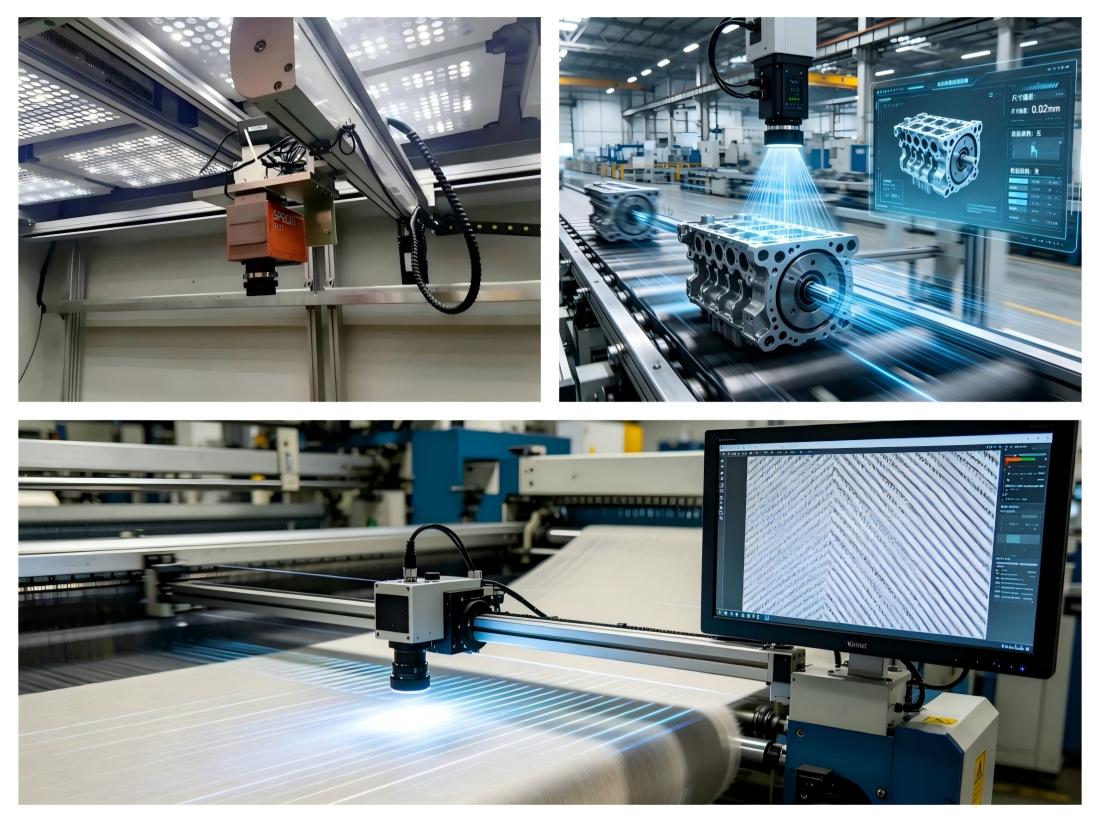
Inspection of automobiles and precision parts
5. Optical films and flexible materials inspection
Various functional film products—such as battery separators, photovoltaic (PV) films, lithium battery electrode films, and optical PET films—have extremely high requirements for surface quality. Tiny defects like pinholes, crystal points (fish-eyes), scratches, dirt, wrinkles, or uneven coatings can directly impact product safety and lifespan. These films are wide-format continuous flexible materials that perfectly match the imaging characteristics of line scan lenses.
For example, as core components of screens for smartphones, tablets, and vehicles, any defect in an optical film directly affects image quality. Using line scan lenses allows for 100% inspection, timely detecting issues like uneven light transmission, surface stains, and coating defects, effectively preventing mass quality incidents caused by manual inspection oversights.
Conclusion
In summary, line scan lenses play a crucial role in industrial inspection with an extremely broad range of applications. The examples above are just the tip of the iceberg. In any scenario involving continuous motion, large formats, or high precision, line scan lenses are likely to be the optimal solution.
Post time: Sep-15-2026


